
Moving from crypto to fiat is simpler than most people think, once you know which method fits your situation. You can convert through centralized exchanges, peer-to-peer platforms, Bitcoin ATMs, or crypto debit cards, with conversion times ranging from milliseconds to several business days. This article breaks down every available method, explains the real costs involved, compares traditional and modern approaches, and helps you choose the fastest and cheapest option for your specific needs. If you’ve ever wondered why your converted amount never quite matches the displayed rate, the answer is in here.
Key Takeaways:
- Moving from crypto to fiat is possible through five main methods: centralized exchanges, P2P platforms, crypto debit cards, Bitcoin ATMs, and OTC desks, each with different speed, cost, and privacy trade-offs.
- Centralized exchanges like Coinbase, Binance, and Kraken typically process withdrawals within 1–5 business days, depending on your bank and region.
- Crypto debit cards are the fastest practical route from crypto to fiat at the point of sale. Conversion happens in milliseconds at the moment of purchase, with no pre-selling required.
- Hidden fees are one of the highest costs in any conversion; always check the spread, withdrawal fee, and network fee before choosing a method.
- Holding crypto in stablecoins like USDT or USDC before converting can reduce volatility risk while keeping assets liquid and ready for fiat withdrawal.
- For frequent spenders, a crypto debit card eliminates the need to manually swap crypto to fiat before every purchase, saving both time and conversion fees.
Why Going From Crypto to Fiat Still Matters
Despite the growth of crypto-native payments, the majority of global commerce still runs on fiat currency. Rent, salaries, and most retail transactions require USD, EUR, or local currency, not Bitcoin or Ethereum.
This creates a practical gap. You may hold significant value in digital assets, but without converting that cryptocurrency to fiat, it remains inaccessible for everyday financial obligations.
The need to convert also arises from portfolio management. Taking profits, rebalancing, or reducing exposure during volatile markets all require an efficient exit from crypto into fiat.
The ability to seamlessly move value between digital and traditional financial systems is what determines whether crypto is truly usable or just speculative.
The Real Cost of Not Having a Conversion Strategy
Without a clear plan, most people convert crypto at the worst possible moment, during panic sells or when urgently needing cash. This leads to higher fees, worse rates, and missed opportunities to maximize the value of your digital assets.
Having a structured approach means you control the timing, the method, and the total cost of every conversion.
How to Convert Crypto to Fiat
There is no single best method; the right choice depends on your speed requirements, transaction size, location, and privacy preferences. Here is a complete breakdown of every available option.
Method 1: Centralized Cryptocurrency Exchanges
Centralized exchanges (CEXs) are the most widely used route for converting crypto to fiat. Platforms like Coinbase, Binance, Kraken, and Gemini allow you to sell your crypto directly for fiat, then withdraw to your bank account.
How it works:
- Create and verify an account on a centralized exchange (KYC required).
- Deposit your cryptocurrency into the exchange wallet.
- Place a sell order, a market order for instant execution, or a limit order for a target price.
- Once sold, your fiat balance appears in your exchange account.
- Initiate a bank withdrawal via SEPA (Europe), ACH (US), or SWIFT (international).
- Funds arrive in your bank account within 1–5 business days, depending on your region.
Key considerations:
- Trading fees typically range from 0.1% to 0.5% per transaction.
- Withdrawal fees vary by currency and payment method.
- KYC verification is mandatory and can take 24–72 hours for new accounts.
- Exchange rates include a spread, the difference between the buy and sell prices, which is an often-overlooked cost.
Centralized exchanges are best for large-volume conversions where rate accuracy and liquidity matter most.
Method 2: Peer-to-Peer (P2P) Platforms
P2P platforms like Paxful and Binance P2P connect buyers and sellers directly. You set your price, choose your payment method, and transact directly with another user, no exchange intermediary involved.
How it works:
- Create an account on a P2P platform.
- Browse sell listings or create your own offer.
- Select a buyer and agree on the rate and payment method.
- The platform holds your crypto in escrow during the transaction.
- Buyer sends payment via bank transfer, PayPal, or other agreed method.
- Confirm receipt and release the crypto from escrow
P2P gives you more flexibility on payment methods and can offer better rates, but carries higher counterparty risk. Always use platforms with escrow protection and verified buyer ratings.
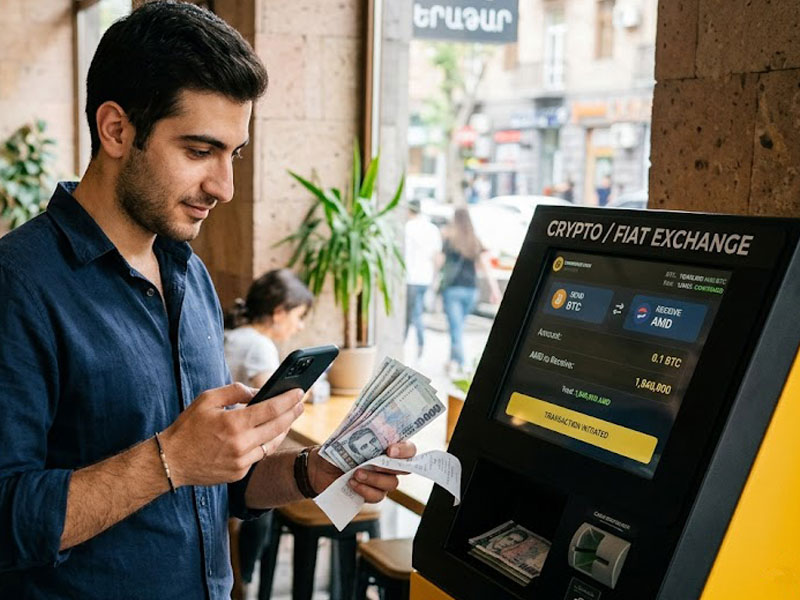
Method 3: Bitcoin ATMs
Bitcoin ATMs let you convert crypto to cash physically, receiving fiat on the spot. There are tens of thousands of Bitcoin ATMs globally, with the highest concentration in the United States.
How it works:
- Locate a Bitcoin ATM near you using CoinATMRadar.com.
- Select the “Sell” option on the machine.
- Enter the amount of crypto you want to sell.
- Send crypto to the ATM’s wallet address shown on screen.
- Collect your cash once the transaction confirms.
The major drawback is cost. Bitcoin ATM fees range from 7% to 20% per transaction, significantly higher than any other method. Best used for small, urgent conversions where speed and privacy matter more than efficiency.
Method 4: Crypto Debit Cards
If you’re new to this space, it helps to first understand what crypto cards are and how they work. Crypto debit cards represent the most modern approach to moving from crypto to fiat.
When you pay at a store or online, your crypto is converted to the local fiat currency at that exact millisecond, using the live market rate. No manual steps. No waiting.
How it works:
- Sign up for a crypto debit card provider and complete KYC.
- Top up your card with cryptocurrency (USDT, BTC, or other supported assets). If you’re doing this for the first time, a step-by-step guide on how to top up a crypto card can walk you through the process.
- Use the card anywhere Visa or Mastercard is accepted, in-store or online.
- At the moment of payment, your crypto converts to fiat automatically, and the merchant receives local currency.
- No manual selling, no withdrawal delays.
For users who regularly spend their crypto rather than hold it long-term, this approach removes the friction of exchange-based conversion entirely. Not sure which card type suits you? Understanding the difference between crypto debit cards and crypto credit cards can help you make the right choice before signing up.
Topex is a crypto debit card built specifically for everyday spending. Your digital assets stay in crypto until the exact moment you make a purchase, so you remain exposed to potential market upside until the last second. The Topex card is accepted at millions of POS terminals and online gateways worldwide, supports Apple Pay and Google Pay, and has a card issuance fee of just $1 with no hidden top-up fees. Use TopexCard with Apple and Google Pay.

Method 5: OTC (Over-the-Counter) Desks
OTC desks are designed for high-volume conversions, typically $50,000 and above. Services like Cumberland, Genesis Trading, and Kraken OTC provide direct trades with a dedicated dealer, bypassing the public order book entirely.
Benefits of OTC:
- No market slippage on large orders.
- Negotiated rates with tight spreads.
- Direct settlement to your bank account.
- Privacy, large trades don’t move the market.
OTC is not relevant for most retail users, but for institutional holders or high-net-worth individuals moving large crypto positions to fiat, it is the most efficient route available.
Traditional vs Modern Crypto Conversion Methods
Understanding the difference between traditional exchange-based conversion and modern crypto card solutions helps you choose the right tool for the right situation.
Traditional methods require you to exchange crypto to fiat through a platform first, wait for funds to clear, then initiate a separate bank withdrawal. The entire process can take 3–7 days and involves multiple fee layers: trading fee, withdrawal fee, and sometimes a network gas fee.
Modern methods, particularly crypto debit cards, collapse this entire process into a single moment. The move from crypto to fiat happens at the point of sale, with no intermediate steps.
| Feature | Centralized Exchange | Bitcoin ATM | Crypto Debit Card |
|---|---|---|---|
| Conversion Speed | 1–5 business days | Immediate (cash) | Milliseconds (at purchase) |
| Fees | 0.1%–0.5% + withdrawal | 7%–20% | Varies by card provider |
| KYC Required | Yes | Sometimes | Yes |
| Usable for Daily Spending | No | No | Yes |
| Requires Pre-Selling | Yes | Yes | No |
| Global Acceptance | N/A | Limited locations | Millions of terminals |
| Hidden Fees Risk | Medium | Low | Low (varies by provider) |
What Is the Cheapest Way to Move From Crypto to Fiat?
The cheapest method depends on your transaction size and urgency.
For amounts under $1,000, a centralized exchange with low trading fees (such as Binance at 0.1%) combined with a free or low-cost withdrawal method (SEPA in Europe) is usually the most cost-effective route.
For daily spending under $500, a crypto debit card with zero top-up fees can actually be cheaper than exchange-based conversion when you factor in the time cost and multiple fee layers of traditional methods.
Hidden costs to always check:
- Spread (the difference between the market price and the rate you receive)
- Network/gas fees for transferring crypto to an exchange
- Withdrawal fees from the exchange to the bank
- Currency conversion fees if withdrawing in a non-native currency
- ATM surcharges (avoid for anything over $100)
Before committing to any card-based approach, looking for a crypto card with low fees across providers will save you money in the long run.
How Long Does It Take to Go From Crypto to Fiat?
Speed varies significantly by method:
- Crypto debit card: Milliseconds, conversion happens at the point of purchase.
- Bitcoin ATM: 10–30 minutes (typically 1 blockchain confirmation required).
- P2P platform: 30 minutes to several hours, depending on buyer response time.
- Centralized exchange (domestic): 1–3 business days via ACH or SEPA.
- Centralized exchange (international): 3–5 business days via SWIFT.
If speed is your priority, crypto debit cards and Bitcoin ATMs are the only two methods that provide same-day or instant fiat access. For large amounts where physical cash isn’t practical, ATMs fall short, making crypto cards the most practical option for fast, everyday conversion.
Timing Your Move From Crypto to Fiat: Why It Matters
Timing your conversion is not just a financial decision; it directly affects your portfolio risk, the rate you receive, and the total value you walk away with.
Converting during a market downturn locks in losses. Converting during a price spike maximizes your realized value. But trying to perfectly time the market is unrealistic for most people.
Practical strategies for timing your conversion:
- Dollar-cost averaging out: Convert a fixed percentage of your holdings each month rather than everything at once. This smooths out market volatility.
- Threshold-based conversion: Set a target price and convert when your asset reaches it, similar to a limit sell order.
- Stablecoin parking: Convert volatile assets (BTC, ETH) to stablecoins (USDT, USDC) first. This locks in your value without immediately triggering a fiat conversion in some jurisdictions, while keeping funds ready for withdrawal when needed.
- Expense-based conversion: Only convert what you need for upcoming expenses. This keeps more of your value in the crypto ecosystem and reduces unnecessary exposure to unfavorable market timing.
Future Investment Strategies When You Convert Crypto to Fiat
Converting from crypto to fiat is not just about cashing out; done strategically, it is a core part of managing a healthy digital asset portfolio.
Rebalancing and Profit-Taking
Most experienced crypto investors do not hold assets indefinitely. They set profit targets and systematically convert a portion of gains into fiat to protect against market corrections. A common approach is the 20/80 rule: convert 20% of gains when a target price is hit, keep 80% invested.
This prevents the scenario where paper profits disappear in a market reversal, a pattern that has repeated across every major crypto market cycle.

Building a Liquidity Reserve
Keeping a fiat reserve, funded by periodic crypto-to-fiat conversions, gives you the ability to buy back during dips without liquidating other assets under pressure.
A 3–6 month expense reserve in fiat is a standard personal finance recommendation. For crypto-heavy portfolios, building this reserve through systematic conversion is sound risk management.
Using Crypto Cards for Lifestyle Spending Without a Full Exit
One underused strategy is using a crypto debit card for day-to-day spending rather than doing full exchange-based conversions. Beyond convenience, the crypto card benefits available today, from rewards programs to global acceptance, make this approach genuinely competitive with traditional banking. This lets you move from crypto to fiat only in the amounts you actually need, at the exact moment of purchase, rather than converting large sums in advance and losing potential upside.
This is particularly useful for users who want to stay invested in crypto markets while still covering everyday expenses. The Topex card keeps your assets in crypto until the millisecond of purchase, meaning your balance continues tracking the market rate right up until you spend it.
Stablecoin Strategies for Intermediate Storage
Many investors move from volatile crypto to stablecoins before converting to fiat. This two-step process, crypto → stablecoin → fiat, lets you lock in value at a specific market price, then choose the optimal time and method for the final conversion.
Stablecoins like USDT, USDC, and DAI are also useful for earning yield through DeFi protocols while maintaining a fiat-equivalent value, giving you flexibility without forcing an immediate exit.
Common Mistakes When Moving From Crypto to Fiat
Even experienced holders make avoidable errors in the conversion process.
- Not comparing rates across platforms: The spread difference between platforms can cost you 1–3% on every transaction. On a $10,000 conversion, that is $100–$300 lost to an easily avoidable inefficiency.
- Ignoring withdrawal limits: Many exchanges have daily withdrawal limits. Converting a large amount only to find you cannot withdraw it immediately causes unnecessary delays and potential exposure to rate changes.
- Forgetting network fees: Sending crypto from a hardware wallet to an exchange costs a network fee. During periods of high congestion on Ethereum, this alone can exceed $50.
- Using Bitcoin ATMs for large amounts: The 7–20% fee at ATMs is justifiable for small, urgent cash needs. For anything over $500, an exchange or crypto card will almost always be cheaper.
How to Choose the Right Method for Your Situation
Your ideal path from crypto to fiat depends on four factors: amount, urgency, frequency, and privacy preference.
- Large one-time conversions ($10,000+): Centralized exchange or OTC desk.
- Regular small conversions for daily spending: Crypto debit card.
- Urgent cash in hand: Bitcoin ATM (accept the fee as a premium for speed and privacy).
- Privacy-sensitive transactions: P2P platforms with cash payment options.
No single method wins across all scenarios. The most financially efficient approach for most users is a combination: an exchange account for large conversions, and a crypto card for day-to-day spending.
Final Thoughts on Crypto to Fiat Conversion
The method you choose when moving from crypto to fiat directly affects how much you receive, how quickly you receive it, and how much value you preserve in the process. There is no universally best approach, only the right tool for each specific need.
For everyday spending, crypto debit cards have eliminated most of the friction that made crypto-to-fiat conversion feel complicated. For larger, strategic conversions, centralized exchanges and OTC desks provide the liquidity and rate accuracy required. And for long-term portfolio health, treating conversion as a deliberate financial decision, rather than a reactive one, consistently produces better outcomes.
The fastest and most efficient ways to move from crypto to fiat are available to anyone today. The question is whether you are using them strategically.
Key Questions About Converting Crypto to Fiat
How do you transfer from a crypto wallet to a fiat wallet?
To move funds from a crypto wallet to a fiat wallet, send your cryptocurrency to a centralized exchange like Coinbase, Binance, or Kraken. Once deposited, place a sell order to convert your crypto into fiat. Then withdraw the fiat balance to your bank account via SEPA, ACH, or SWIFT. The full process typically takes 1–5 business days, depending on your region and withdrawal method.
How do crypto cards convert crypto to fiat at the point of sale?
When you purchase with a crypto debit card, the card provider fetches the live market rate at that exact millisecond and converts the required amount of crypto into fiat automatically. The merchant receives local currency as with any standard card payment, no manual conversion or pre-selling required on your end. The entire process happens in the background, instantly.
What is the fastest way to go from crypto to fiat?
Crypto debit cards are the fastest practical method; conversion happens in milliseconds at the point of purchase, with no pre-selling or bank waiting period required. Bitcoin ATMs are the fastest option for receiving physical cash, typically within 10–30 minutes.
What is the fastest way to go from crypto to fiat?
Crypto debit cards are the fastest practical method; conversion happens in milliseconds at the point of purchase, with no pre-selling or bank waiting period required. Bitcoin ATMs are the fastest option for receiving physical cash, typically within 10–30 minutes.
What are the fees for converting from crypto to fiat?
Fees vary by method: centralized exchanges charge 0.1%–0.5% in trading fees plus withdrawal fees; Bitcoin ATMs charge 7%–20%; crypto debit cards vary by provider but often have low or zero top-up fees. Always check the spread in addition to stated fees, as this is often the highest hidden cost.
Can I go from crypto to fiat without using an exchange?
Yes. P2P platforms allow direct transactions between individuals. Crypto debit cards convert assets automatically at the point of sale. Bitcoin ATMs provide cash without requiring an exchange account. However, all regulated methods still require some form of identity verification for compliance purposes.