

If you are asking which crypto to buy today for the long term, the right answer is not the newest coin on social media. It is the asset with real utility, durable adoption, strong token design, and enough staying power to survive multiple market cycles.
This guide explains long-term crypto investing in simple, easy-to-understand language. You will see how to judge major assets, how to think about portfolio construction in 2026, which trends matter, and why capital preservation matters just as much as upside. Bitcoin remains the best-known decentralized monetary network, Ethereum is still the leading smart-contract platform, and projects like Solana, Chainlink, Avalanche, XRP Ledger, Polkadot, BNB Chain, Cardano, and Litecoin each occupy a different role in the market.
Long-term winners in crypto rarely win because they were “cheap.” They win because they solve a real problem, keep attracting builders, and remain useful after the hype fades.
What Does “Long-Term Crypto Investing” Really Mean in 2026?
How long is “long-term” in crypto markets? For most investors, it means holding through at least one full market cycle, usually 3 to 5 years or longer, instead of trying to predict the next 30-day move. In practice, long-term investing means buying assets with a thesis that can still make sense after the next bull run, the next bear market, and the next wave of regulation.
Why does that matter? Crypto prices are still driven by narratives, liquidity, and reflexive cycles, but network value is built by usage, infrastructure, and survival. Bitcoin is designed as a peer-to-peer digital money system, Ethereum is a global platform for applications and assets, and Solana, Cardano, Polkadot, Chainlink, BNB Chain, Avalanche, XRPL, and Litecoin each focus on a different type of network utility.
Why long-term investing outperforms market timing comes down to behavior. Most traders do not fail because they choose “bad” assets; they fail because they overtrade, undersize risk, and get forced out by volatility. Long-term investors are more likely to capture compounding because they give strong networks time to mature while avoiding the emotional cost of constant re-entry.
Investing in technology, not just price movements, changes the whole framework. If you are buying a blockchain, you are really buying access to a network effect: developers, users, liquidity, integrations, security, and ecosystem depth. That is why a serious investor looks at the product, not just the chart.
Long-Term Investing vs Short-Term Trading: Which Strategy Is Right for You?
Which strategy fits you better: investing or trading? Long-term investing suits people who want lower activity, lower stress, and a thesis they can hold through volatility. Short-term trading suits people who can monitor markets closely, accept higher decision frequency, and handle emotional pressure without breaking rules.
The biggest differences are risk, effort, and time commitment. A long-term investor may review their portfolio weekly or monthly, while a trader may need to watch price action, news flow, funding rates, and technical setups every day. In a bull market, both approaches can look smart; in a bear market, the trader often gets chopped up by noise while the investor must survive drawdowns without panic selling.
Here is the practical comparison:
| Factor | Long-Term Investing | Short-Term Trading |
|---|---|---|
| Time Horizon | Months to years | Minutes to weeks |
| Time Commitment | Low (weekly/monthly review) | High (daily monitoring) |
| Effort Level | Moderate | High |
| Stress Level | Lower | Higher |
| Decision Frequency | Infrequent | Frequent |
| Required Skills | Patience, fundamental analysis | Technical analysis, fast decisions |
| Market Monitoring | Occasional | Constant |
| Risk Exposure | Long-term volatility | Short-term price swings |
| Bull Market Behavior | Steady growth | Potential high gains |
| Bear Market Behavior | Hold through drawdowns | Higher loss risk from volatility |
| Emotional Pressure | Manageable | Intense |
| Best For | Busy individuals, long-term planners | Active traders, fast decision-makers |
| Main Advantage | Simplicity and sustainability | Flexibility and opportunity |
| Main Challenge | Patience during downturns | Avoiding emotional mistakes |
Choosing a strategy based on your lifestyle and goals is the real separator. If you have a full-time job, family commitments, or no desire to watch charts all day, long-term investing is usually the better model. If you love active decision-making and can accept a higher failure rate, trading may suit you better, but it should be a separate skill set, not a side effect of boredom.
How to Choose the Best Crypto for Long-Term Investment
In long-term crypto investing, the main challenge is understanding why some projects survive multiple market cycles while others disappear despite strong hype. The key difference is not short-term attention, but strong fundamentals that can sustain growth over a 5-year horizon.
The best long-term crypto assets are typically built on real utility, active developer ecosystems, solid tokenomics, strong security, and realistic adoption pathways.
For example, Bitcoin functions as a digital store of value and payment network, while Ethereum powers decentralized applications and smart contracts. Solana focuses on fast and low-cost transactions, Chainlink connects blockchains to real-world data, XRPL is designed for cross-border payments, and networks like Avalanche and Polkadot emphasize scalability and interoperability.
Developer activity is a major indicator of long-term potential. Networks that attract builders tend to grow stronger because apps, liquidity, and integrations expand over time. This is why Ethereum leads Web3 development, while Solana and Polkadot continue to expand their ecosystems in different directions.
Tokenomics also plays a critical role. Even strong projects can underperform if supply growth outweighs demand. Factors like inflation rates, token unlock schedules, staking rewards, and fee burns directly impact long-term value.
Security and decentralization further determine resilience. Bitcoin remains highly secure due to its simple and decentralized design, while Ethereum and Cardano focus on continuous improvements in scalability and protocol security.
Finally, adoption and real-world integration matter most for survival. Projects that can fit into payment systems, institutional use cases, and compliant financial rails have a much higher chance of long-term success.
Key factors to evaluate:
- Real-world utility
- Developer ecosystem growth
- Tokenomics structure
- Security and decentralization
- Adoption and regulatory fit
- Market position and competitiveness
Ultimately, successful long-term crypto investing is about identifying projects that are building real infrastructure, not just riding market hype.
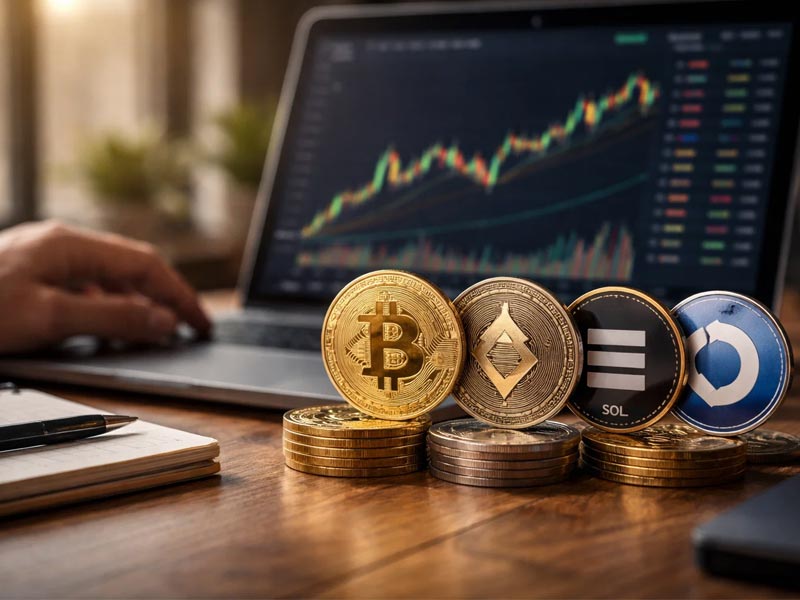
Top Cryptocurrencies to Buy Today for Long-Term Investment
Before diving into specific assets, it’s important to understand that long-term crypto investing isn’t about chasing short-term trends. Each project plays a different role in the broader ecosystem; some act as core stores of value, while others focus on infrastructure, scalability, or real-world utility. The list below highlights established cryptocurrencies that have shown strong fundamentals and continued relevance over time.
Bitcoin (BTC)
Bitcoin has established itself as the most trusted digital store of value in the crypto market, often compared to digital gold due to its scarcity and growing institutional acceptance.
What makes Bitcoin unique is its fixed supply model, permanently capped at 21 million coins. This built-in scarcity cannot be changed, which creates a strong long-term value narrative in contrast to traditional currencies that can be expanded through monetary policy. Over time, Bitcoin has evolved from an experimental peer-to-peer payment system into a globally recognized reserve-like asset, increasingly held by institutions, corporations, and long-term investors.
This shift in perception is mainly driven by a few core characteristics that consistently define Bitcoin’s role in portfolios:
- Fixed supply of 21 million BTC, creating predictable scarcity
- Strong institutional adoption trend across funds and corporations
- High network security supported by global decentralization
- Widespread recognition as “digital gold” in modern investment strategies
Because of this combination, Bitcoin continues to stand out as the core long-term holding for investors who prioritize stability and simplicity in the crypto market.
Ethereum (ETH)
Ethereum is widely regarded as the foundational infrastructure powering most decentralized applications, ranging from DeFi protocols to NFTs and tokenized real-world assets.
What makes Ethereum particularly important is that it was the first blockchain to successfully introduce and scale smart contracts at a global level. This allowed developers to move beyond simple transactions and start building fully programmable financial systems and decentralized applications. Even with growing competition from newer blockchains, Ethereum continues to lead in developer activity and overall ecosystem depth.
A key reason for this continued dominance is its ongoing evolution toward Layer 2 scaling solutions, which significantly improve transaction speed and reduce costs while maintaining security at the base layer. This combination has strengthened Ethereum’s role as the settlement layer of Web3 and expanded what can realistically be built on top of it.
In practice, this dominance is reflected in several clear ecosystem advantages:
- Largest ecosystem of decentralized applications across Web3
- Strong dominance in DeFi protocols and stablecoin activity
- The rapid expansion of Layer 2 scaling networks is improving performance
- Highest level of developer activity and continuous protocol innovation
Because of this, Ethereum remains a core infrastructure layer for anyone focused on the long-term future of decentralized internet systems and on-chain finance.
Solana (SOL)
Solana (SOL) has positioned itself as a high-performance blockchain built specifically for large-scale consumer applications and real-time digital activity.
The main idea behind Solana is simple: prioritize speed and cost efficiency above everything else. Its architecture is optimized for extremely high throughput, allowing thousands of transactions per second while keeping fees very low. This makes it especially relevant for use cases like gaming, payments, and high-frequency decentralized applications where user experience depends heavily on speed.
Although Solana has experienced some network stability issues in the past, it has continued to attract strong developer interest, and its ecosystem has been expanding rapidly as more consumer-focused applications are built on top of it.
This combination of performance and adoption is reflected in a few key strengths:
- Extremely high transaction speed supporting real-time applications
- Very low fees that improve accessibility for users
- Strong focus on consumer-facing use cases like gaming and payments
- Rapid ecosystem growth across DeFi, NFTs, and Web3 applications
Because of this profile, Solana is often viewed as a high-beta infrastructure play that is closely tied to the broader wave of mainstream crypto adoption.
Chainlink (LINK)
Chainlink (LINK) plays a foundational role in connecting blockchain networks with real-world data and external systems.
The core limitation of blockchains is that they operate in isolation and cannot directly access off-chain information like prices, APIs, or financial data. Chainlink solves this problem by acting as a secure middleware layer that delivers trusted external data into smart contracts. This capability is essential for a wide range of applications, especially in DeFi, tokenized assets, insurance systems, and any protocol that depends on accurate real-world inputs.
In practice, this infrastructure value is reflected in a few clear functions:
- Secure bridge between blockchain networks and real-world data
- Essential infrastructure for DeFi and tokenized financial systems
- Cross-chain interoperability support across multiple ecosystems
- Widely integrated Oracle standard across Web3 applications
Because of this role, Chainlink is considered a core infrastructure layer for expanding what smart contracts can actually do in real-world use cases.
Polygon (POL / MATIC)
Polygon extends Ethereum’s capabilities by offering scalable and low-cost transaction environments for decentralized applications.
As Ethereum usage has grown, network congestion and high gas fees have become a real limitation for everyday applications. Polygon addresses this by providing Layer 2 solutions and sidechains that help process transactions faster and at a much lower cost, while still remaining compatible with Ethereum’s ecosystem. This makes it easier for developers and enterprises to build user-friendly applications without being constrained by high fees.
This practical value is usually reflected in a few key advantages:
- Reduces Ethereum transaction costs for users and developers
- Supports multiple scaling architectures, including Layer 2 and sidechains
- Strong adoption from both enterprises and Web3 developers
- Enhances usability of Ethereum-based applications at scale
Because of this, Polygon plays an important role in extending Ethereum’s reach toward broader and more practical mass adoption use cases.
Arbitrum (ARB)
Arbitrum is one of the most widely used Layer 2 scaling solutions for Ethereum, designed to improve transaction efficiency while still preserving Ethereum’s core security.
The way it works is by using optimistic rollups, which process transactions off-chain first and then submit them back to Ethereum for final settlement. This approach significantly reduces costs and improves speed, while still relying on Ethereum for security guarantees. As a result, Arbitrum has become a preferred choice for many DeFi protocols and decentralized applications that need scalability without compromising trust.
In practice, its role in the ecosystem is reflected in a few key strengths:
- Major Layer 2 scaling solution built on Ethereum
- High adoption across DeFi and on-chain ecosystems
- Low-cost and efficient transaction processing at scale
- Strong alignment with Ethereum’s security model
Because of this, Arbitrum is considered a key infrastructure component in Ethereum’s long-term scaling roadmap.
Avalanche (AVAX)
Avalanche enables the creation of customizable blockchain networks designed for specific applications and industries.
Instead of forcing every application to run on a single shared environment, Avalanche introduces a subnet architecture that allows developers to build their own tailored blockchains. These can be optimized for performance, regulatory requirements, or specific functionality depending on the use case. This flexibility is especially valuable for sectors like gaming, enterprise infrastructure, and financial systems, where different applications often need different technical environments.
This design approach translates into a few clear advantages:
- Custom blockchain creation through subnet architecture
- High scalability with strong performance capabilities
- Flexible framework adaptable to different industries
- Strong adoption focus in enterprise and gaming ecosystems
Because of this, Avalanche is often viewed as a network built for a multi-chain, application-specific future where different blockchains serve different purposes.
XRP (Ross-Border Payment Infrastructure)
XRP is focused on enabling fast, low-cost, and efficient cross-border payment and settlement systems.
Instead of targeting general-purpose blockchain use cases, XRP is built specifically to improve how money moves across borders. It reduces friction between different currencies and traditional banking systems, aiming to make global transfers faster and cheaper. Its strongest use case has traditionally been in remittances and institutional payment flows, although its long-term success still depends heavily on regulatory clarity and broader financial adoption.
In practical terms, its value proposition is usually reflected in a few key characteristics:
- Fast global payment settlement with minimal delay
- Low-cost cross-border transfer capability
- Focus on institutional and banking-related financial systems
- Competition with emerging stablecoin-based payment rails
Because of this positioning, XRP continues to be seen as a payment-focused crypto asset with potential for real-world utility in global financial infrastructure.
Litecoin (LTC)
Litecoin is one of the longest-standing cryptocurrencies, designed specifically for fast, simple, and low-cost digital payments.
It was created as a lightweight alternative to Bitcoin, with a clear focus on improving transaction speed and overall efficiency. Unlike newer smart contract platforms, Litecoin doesn’t aim to support complex decentralized applications. Instead, it prioritizes reliability and consistent performance, which comes from its long track record in the market and stable network design.
That practical positioning is usually reflected in a few key characteristics:
- Fast transaction processing with quick confirmations
- Low fees that make small payments more practical
- Simple and stable network design focused on usability
- Long-standing presence with proven operational history
Because of this, Litecoin continues to serve as a durable and conservative option for basic digital payments.
Additional Notable Cryptocurrencies
- Polygon (POL), Arbitrum (ARB), and Optimism (OP): Key Ethereum scaling ecosystems driving Layer 2 adoption.
- Cosmos (ATOM) – Interoperability Network: Designed for connecting independent blockchains into a unified ecosystem.
- Near Protocol (NEAR) – Developer-Friendly Smart Contract Platform: Focused on usability, scalability, and simplified blockchain development.
- Toncoin (TON) – Messaging-Driven Blockchain Ecosystem: Integrated with large-scale messaging distribution networks for mass adoption potential.
High-Growth Crypto Narratives to Watch
Which narratives matter beyond the large-cap names? The answer is the themes that can attract capital even when individual coins rotate out of favor. In 2026, the biggest long-term storylines are still tied to infrastructure, tokenization, and automation.
AI-powered cryptocurrencies are mostly about connecting blockchains to off-chain computation, data, and machine coordination. The most durable projects in this category will not just add “AI” to a token name; they will help decentralized applications request data, verify outputs, and automate workflows at scale. That is why infrastructure layers that support off-chain data and computation remain relevant.
Layer 2 scaling solutions remain important because Ethereum’s roadmap is still centered on rollups and cheaper transaction capacity for users. If fees stay lower and throughput keeps improving, more apps can live on-chain without pricing out normal users.
Modular blockchain architectures matter because they split responsibilities across specialized layers instead of forcing one chain to do everything. Celestia describes modular blockchains as a way to improve scalability and efficiency by dividing tasks among specialized layers. That design is attractive because it can reduce bottlenecks and make it easier to tailor chains to specific workloads.
Real-world asset tokenization is one of the most practical narratives because it connects crypto infrastructure to traditional financial products, treasuries, and settlement systems. Chainlink’s positioning around tokenized assets and capital markets shows how infrastructure can sit underneath this trend.
Gaming and metaverse infrastructure is still a live niche, but only the projects that make onboarding, ownership, and transaction costs invisible are likely to last. Cheap, fast, and user-friendly chains have the clearest edge here.

How to Build a Strong Long-Term Crypto Portfolio
A serious long-term crypto portfolio is not a random mix of coins. It is built around a clear investment thesis, defined risk limits, and an honest understanding of how much volatility you can handle. A structured approach helps you stay consistent even during strong market cycles.
- Start with a clear portfolio thesis: Define why you are investing in crypto in the first place. Your portfolio should reflect a long-term belief system, whether that is digital money, smart contract platforms, or blockchain infrastructure, not short-term hype or trends.
- Use a core vs. satellite structure: Split your portfolio into two layers:
- Core (around 70%): Stable, high-conviction assets like Bitcoin (BTC) and Ethereum (ETH) that anchor long-term performance.
- Satellite (around 30%): Higher-risk assets with more upside potential, such as Solana (SOL), Chainlink (LINK), Avalanche (AVAX), Polkadot (DOT), Cardano (ADA), XRP, Binance Coin (BNB), or Litecoin (LTC), depending on your conviction.
- Diversify across sectors, not just coins: Avoid concentration in a single narrative. A balanced portfolio typically spreads exposure across:
- Store of value (e.g., BTC)
- Smart contract platforms (e.g., ETH, SOL, ADA, AVAX)
- Oracles (e.g., LINK)
- Payment networks (e.g., XRP, LTC)
- Interoperability or scaling ecosystems (e.g., DOT)
- Control position sizing carefully: Crypto volatility can be extreme even when the long-term thesis is correct. A practical approach is to allocate only 5–10% of total investable assets to crypto if you are a beginner or moderate-risk investor. Within that, keep individual altcoin positions small enough that one failure does not significantly impact your overall portfolio.
- Rebalance across market cycles: Strong portfolios are actively managed over time. When a position grows far beyond its intended weight, gradually trimming helps lock in profits and reduce concentration risk. This is especially important in crypto, where strong performers can quickly dominate portfolio exposure.
A well-built crypto portfolio is less about picking perfect coins and more about maintaining structure, discipline, and balance through every market cycle.
Risks of Long-Term Crypto Investing
Can long-term investing still go badly? Absolutely. The biggest mistake is assuming that simply holding for longer automatically makes an asset safer. In crypto, weak projects can still go to zero, even after years of patience.
A long-term strategy needs to account for several important risks:
- Extreme volatility and deep drawdowns: Large market corrections are normal in crypto. Investors must be able to survive sharp declines without panic-selling at the worst possible time.
- Regulatory and legal uncertainty: Rules can change quickly across regions. Tokens may face restrictions, exchanges can lose access, and compliance requirements can shift the investment case overnight.
- Security and custody risks: Wallet errors, exchange failures, phishing attacks, and loss of private keys remain common causes of capital loss. Custody should be treated as a core operational responsibility.
- Token inflation and insider selling pressure: Even strong projects can suffer if supply growth outpaces demand. Emissions, unlock schedules, and reward systems can suppress price performance for long periods.
- Market manipulation and scams: Low liquidity, hype-driven narratives, and anonymous teams make crypto vulnerable to manipulation. Many losses come from chasing low-quality or unverified projects.
A sustainable long-term approach focuses on risk control: careful position sizing, strong conviction backed by research, and avoiding emotional decisions during market stress.
Can You Find a 100x or 1000x Crypto for the Long-Term?
Extremely high-return crypto investments are possible, but they come with a very uneven distribution of outcomes. A small number of tokens can deliver massive gains, while the vast majority fail or lose most of their value. The key is understanding that asymmetric upside always comes with a high probability of failure.
A realistic way to think about “moonshot” opportunities includes several core principles:
- Asymmetric upside is real, but rare: A small allocation can sometimes turn into a large winner, but this outcome is exceptional, not normal. It should never be treated as the base case.
- Position sizing is more important than conviction: Moonshot bets should always be small and capped. The goal is exposure to upside, not reliance on the outcome.
- Survivorship bias distorts perception: Most attention goes to the few tokens that succeeded massively, while hundreds of failed or abandoned projects are forgotten.
- Why most microcap tokens fail: Many early-stage projects lack one or more critical factors:
- real users or demand
- liquidity and market depth
- active builders or development teams
- security and resilience
- a clear long-term purpose or utility
- Exit strategy matters more than entry timing: Small-cap tokens can rise quickly but also collapse just as fast. Taking partial profits and managing exposure often matters more than trying to perfectly time the entry or exit.
In practice, the smartest approach to high-risk crypto bets is disciplined exposure: accept that most will fail, but structure the position so that a single winner can still matter.
How to Invest in Crypto for the Long-Term
A safe long-term crypto strategy is not complicated, but it does require structure and discipline. The goal is to reduce unnecessary risk, avoid emotional decisions, and build a system that you can consistently follow over time. Simplicity usually leads to better outcomes than complex or aggressive setups.
A practical approach typically includes the following elements:
- Start with a reliable exchange: Use a reputable platform with strong security, clear fee structure, regulatory compliance, reliable withdrawals, and protection features like two-factor authentication. Treat the exchange as an entry point, not a storage solution.
- Use self-custody for long-term holdings: Move long-term assets into a hardware wallet or secure offline storage. This reduces counterparty risk by giving you full control over private keys instead of relying on centralized platforms.
- Separate trading funds from long-term capital: Keep only active trading funds on exchanges. Long-term holdings should stay offline to minimize exposure to hacks, insolvency, or platform issues.
- Avoid common beginner mistakes: Most losses come from poor discipline rather than bad assets. Key mistakes to avoid include:
- chasing short-term price pumps
- using excessive leverage
- over-diversifying into too many weak positions
- confusing hype with long-term value
- Keep a simple and repeatable process: A consistent strategy is more effective than constantly changing approaches. A “boring” plan that you can follow for years usually outperforms reactive decision-making.
- Understand taxes and reporting requirements: Every transaction may have tax implications depending on your jurisdiction, including buys, sells, swaps, rewards, and spending. Maintaining clear records from the beginning prevents problems later.
A strong long-term crypto setup is less about finding perfect timing and more about building habits that protect capital and reduce avoidable risk.
How to Turn Long-Term Crypto Holdings into Real-World Value with TOPEX
How do you actually use your crypto beyond just holding it for years?
Long-term investing only makes sense when your assets can eventually connect to real spending, rewards, and financial utility.
Today, the strongest portfolios are not just about accumulation; they are about activation of value through payment layers, spending tools, and reward systems like TOPEX.
Everyday Spending: Using Crypto in Daily Life
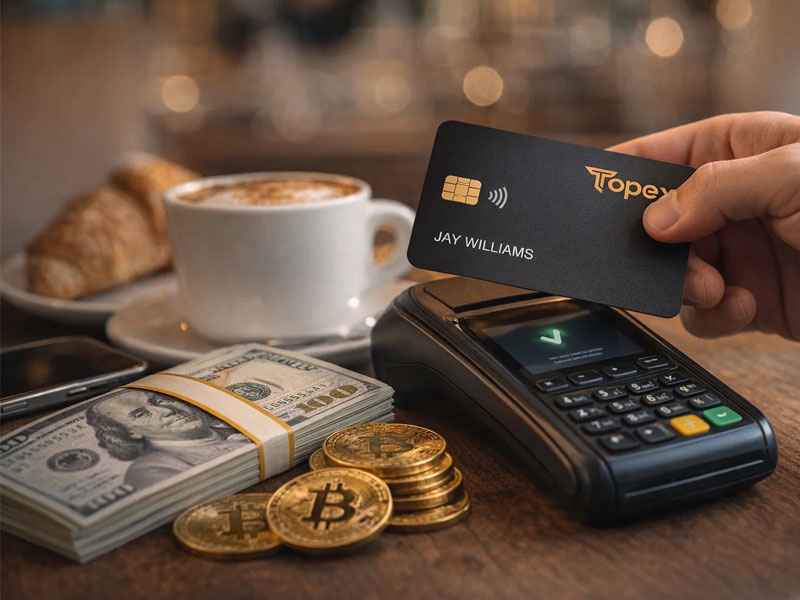
If you’re focused on long-term investing, one of the real challenges is still simple: you need access to everyday money without being forced to sell your crypto at the wrong time. A modern crypto debit card helps solve that by letting you spend directly from your digital assets while still keeping your long-term positions intact.
Here’s why people use it:
- You can spend crypto instantly without having to manually convert it first
- Your portfolio stays invested while you cover daily expenses
- It reduces the friction between long-term investing and real-world payments
Travel Without Converting Assets at Bad Rates
Traveling while holding crypto usually comes with a frustrating trade-off: you end up converting assets at the wrong time or through exchanges that quietly eat into your value. A better approach is using a crypto debit card for travel, which lets you spend directly from your crypto balance while you’re abroad, without constantly worrying about conversions.
Here’s what makes it useful:
- You can pay globally without needing to convert everything into fiat first
- Transactions are automatically converted at the point of sale in real time
- You avoid extra FX fees and annoying withdrawal charges while traveling
Business and Corporate Use Cases
When businesses or individuals hold crypto as part of their treasury, things get tricky pretty quickly. Entrepreneurs, freelancers, and companies often struggle to actually use those assets for day-to-day operations in a controlled way.
That’s where a crypto corporate card comes in. It helps connect crypto holdings with real business spending in a structured and manageable way.
Here are some common use cases:
- Paying operational expenses directly from crypto reserves
- Managing team spending with clear limits and controls
- Keeping transparent records of all corporate crypto transactions
Rewards Layer: Turning Spending into Value
Modern crypto finance isn’t just about holding assets anymore, and it’s not even only about spending them. It’s increasingly about getting value back every time you use them. A crypto cashback card fits into this shift by letting users earn rewards, loyalty points, and merchant perks while they spend, without changing how they already shop.
Here’s what that typically looks like:
- Cashback on everyday purchases you’re already making
- Loyalty tiers that unlock better rewards the more you use the card
- Extra bonuses and exclusive offers from selected merchants
Why This Matters for Long-Term Investors?
Long-term crypto strategy is no longer just “buy and hold.”
It is becoming a full financial loop:
- Invest in assets (BTC, ETH, altcoins)
- Store value securely over cycles
- Activate liquidity when needed
- Earn rewards while spending
This is exactly where platforms like TOPEX position themselves, as the execution layer between holding and real-world utility.
Key Trends That Will Shape the Future of Cryptocurrency
The first big trend is scaling. Ethereum’s roadmap is still moving toward cheaper, more efficient rollup-based activity, and that will keep shaping where users and builders choose to operate.
The second trend is modular design. Instead of one chain trying to do everything, more systems are splitting execution, data availability, and settlement across specialized layers. Celestia’s official materials describe that shift clearly, and the logic is straightforward: specialization can improve scalability and reduce congestion.
The third trend is tokenization and on-chain finance. Chainlink’s emphasis on tokenized assets and capital markets reflects a broader move toward bringing more real-world financial data and assets onto blockchain rails. That is a major long-term catalyst because it expands crypto beyond speculation into infrastructure.
The fourth trend is payments and settlement. XRPL, Litecoin, and parts of the BNB Chain and Solana ecosystems are all positioned around faster, cheaper transfers and practical transaction use cases. The next wave of crypto adoption is likely to reward networks that move value more simply, not more complicated.
The fifth trend is user-friendly infrastructure. Wallets, custody, compliance, and payment tools will matter more as crypto becomes less experimental. That is also where spending tools like a crypto card can fit into a broader strategy: not as the core thesis, but as a practical bridge between on-chain assets and real-world spending.
Key Takeaways
- Long-term crypto investing is about surviving full market cycles, not guessing the next weekly move.
- Bitcoin and Ethereum remain the strongest core assets for many portfolios because of network strength and utility.
- Solana, Chainlink, Avalanche, Polkadot, BNB, XRP, Cardano, and Litecoin each represent different infrastructure or payment theses.
- The best portfolios combine core assets, smaller satellite bets, and strict position sizing.
- Security, custody, taxes, and regulation matter as much as price prediction.
- The strongest long-term narratives in 2026 are scaling, modularity, tokenization, and payments.
FAQ
Which crypto to buy today for long-term 2030?
For a 2030 horizon, most long-term portfolios focus on Bitcoin and Ethereum as core holdings due to their established networks, adoption, and resilience across market cycles. Around these, investors often add selective exposure to high-utility ecosystems like Solana, Chainlink, and other infrastructure-focused projects, depending on risk tolerance and diversification strategy.
What is the biggest mistake long-term crypto investors make?
The biggest mistake is overallocating to speculative tokens or taking positions so large that normal volatility forces a panic sell. Good long-term investing is mostly about survival, sizing, and discipline.
How do I know if a crypto project will survive long-term?
Look for consistent developer activity, real user adoption, clear use cases, and strong tokenomics. Projects that continue building and attracting users during bear markets are more likely to survive over the long run.
Should I keep buying crypto regularly or invest all at once?
Many investors prefer dollar-cost averaging (DCA), where they invest a fixed amount over time. This reduces the impact of market volatility and avoids the risk of entering at a poor price point.
Is it better to invest in one crypto or diversify across several?
Diversification is generally the safer approach. Holding a mix of established assets and a few high-potential projects reduces the risk of relying on a single outcome while still allowing for growth opportunities.