

A crypto card is worth it if you regularly earn, hold, or spend digital assets and want to use them in daily life without manual conversions, but it is rarely worth it for passive long-term investors who barely touch their holdings. The real answer depends on your spending frequency, your tolerance for price volatility, and how transparent the card’s fee structure is. This guide breaks down exactly who benefits, who doesn’t, what hidden costs to watch for, and how to run the math before you apply. By the end, you’ll know whether applying makes financial sense for your specific situation, or whether you’re better off staying with traditional payment methods.
Key Takeaways:
- A crypto card is worth it mainly for users who spend from their digital assets at least several times per week, not for passive long-term holders.
- The break-even point typically appears when monthly spending volume offsets fixed costs like conversion spreads, top-up fees, and any subscription charges.
- Funding the card with stablecoins instead of volatile assets eliminates most price-risk concerns while preserving daily usability.
- Freelancers paid in crypto, frequent online shoppers, and international travelers see the strongest value, while occasional users often pay more than they save.
- Hidden costs such as conversion spreads of 0.5%–2%, ATM withdrawal fees, and inactivity charges can quietly erase the headline benefits if usage stays low.
- Choosing a card with transparent pricing, free top-ups, and low issuance costs significantly improves the cost-benefit ratio from day one.
- The decision should be based on how you actually spend money today, not on aspirational habits you hope to adopt later.
What Does “Worth It” Really Mean for a Crypto Card User
A crypto card is worth it when it consistently saves you time, fees, or friction compared to alternative ways of converting and spending your digital assets. The question isn’t whether the product is good, it’s whether it fits the way you actually move money.
Most people frame value purely around rewards or convenience, but that’s an incomplete picture. The real measure is whether the card meaningfully improves the path between holding crypto and spending it, while keeping total cost lower than your next-best option. If you’d otherwise sell on an exchange, wait for a bank transfer, and then pay with a debit card, a crypto card collapses that into a single transaction. That compression has real economic value, but only if you actually go through that loop often enough to matter.
The other side of the equation is opportunity cost. Every dollar you spend from a crypto card is a dollar you’ve removed from a position that might appreciate. If you don’t think about this trade-off, the card can quietly cost you more than its rewards return. If you’re still uncertain about the underlying product, our breakdown of what a crypto card is covers the foundational mechanics.
Worth It vs. Useful: Why They’re Not the Same
A crypto card can be useful in occasional situations without being worth applying for. Useful means it works when you need it. Worth it means the total annual value, time saved, friction avoided, and any rewards earned, exceeds the total annual cost, including fees, spreads, and opportunity cost on the funds you keep loaded.
Run that calculation honestly. A card you use four times a year for travel emergencies is useful, but the annual fees, inactivity charges, or unused balance volatility may make it not worth it. The distinction matters because most marketing focuses on usefulness while users actually need to evaluate true cost-benefit.
Who Actually Gets Real Value From a Crypto Card
Crypto cards deliver measurable value to a specific set of user profiles, and outside those profiles, the financial case weakens quickly. The clearest winners share one trait: they already interact with digital assets frequently and need a smoother bridge to everyday spending.
The user profiles where a crypto card consistently pays off:
- Crypto earners and freelancers: If part of your income arrives in crypto, a card removes the multi-step exchange-and-withdraw process and turns earnings into spending power immediately.
- High-frequency digital spenders: People who pay for subscriptions, groceries, online services, and travel weekly accumulate enough transaction volume to offset fixed costs.
- International travelers and remote workers: Multi-currency support and reduced FX friction make a crypto card meaningfully cheaper than traditional foreign-transaction debit cards.
- Users in regions with limited banking access: Where opening a traditional bank account is slow, expensive, or restricted, a crypto card provides functional payment access without the same documentation hurdles.
If you fit two or more of these profiles, the math almost always favors applying. If you fit none, you’re likely better off keeping your crypto in cold storage and using a traditional card for daily purchases.
When a Crypto Card Is NOT Worth It
A crypto card is not worth it when you rarely spend from your holdings, treat crypto strictly as a long-term store of value, or want predictable monthly budgeting without checking market prices. In these cases, the card adds friction rather than removing it.
The clearest red flags that you should skip applying:
- You hold crypto for multi-year appreciation and have no plans to spend it
- Your monthly transaction volume from crypto would be under 5–10 purchases
- You strongly dislike monitoring exchange rates or thinking about timing
- You want a strict separation between your investment portfolio and your daily wallet
- You’re in a region where merchant acceptance is limited, and ATM withdrawals are your only realistic use
Long-term investors are the most common mismatch. Spending a small amount of Bitcoin today that appreciates 3x over the next two years means you effectively overpaid by three times for that coffee. That’s not a flaw in the card; it’s a flaw in pairing a long-term-hold strategy with a daily-spend tool. If your goal is to grow your portfolio rather than spend from it, strategies like staking, yield farming, or other approaches covered in how to make passive income with crypto deliver returns that a card simply isn’t designed to provide. For investors who prefer manual liquidation only when fiat is actually needed, our guide on converting from crypto to fiat covers the alternative path.
The Hidden Costs That Can Cancel Out the Benefits
The biggest reason users abandon crypto cards within the first six months is that hidden costs eat up the perceived benefits. Headline rewards rates and “no annual fee” messaging often mask the real total cost of ownership.
Conversion spreads are usually the highest hidden cost. Most providers convert crypto to fiat at a rate that includes a markup of roughly 0.5% to 2% above market rate, which doesn’t appear as a line-item fee but reduces every transaction’s value. On top of that, inactivity fees, ATM withdrawal charges, foreign transaction add-ons, and minimum spending thresholds for rewards can all chip away at the math.
“Cards with the highest advertised rewards often have the highest hidden costs. Always calculate net benefit on real spending volume, not on the headline rate.”
This is exactly why looking for a crypto card with low fees and transparent pricing matters more than chasing the highest cashback percentage. A 2% reward rate on a card with a 1.5% conversion spread leaves you with 0.5% net, before any other fees apply.
How to Calculate the True Cost Before Applying
To know whether a crypto card is worth applying for, run a simple four-step calculation rather than trusting the marketing.
- Estimate your realistic monthly spending volume in USD or your local currency.
- Identify every fee that applies to your usage pattern: conversion spread, monthly fee, ATM fees, top-up fees, and inactivity charges.
- Multiply the conversion spread by your monthly volume to get the real recurring cost.
- Subtract total monthly cost from any rewards or savings the card delivers; if the result is negative or near zero, the card is not worth it for you.
This calculation surfaces the truth quickly. A card with $0 monthly fees, free top-ups, and minimal spreads beats a higher-reward card with multiple hidden charges in almost every realistic spending scenario.
How Much Do You Need to Use It for It to Pay Off
You generally need to use a crypto card several times per week, or at a minimum of 15–25 transactions per month, for it to clearly pay off. Below that threshold, fixed costs dilute the value, and rewards rarely catch up.
Crypto cards are designed around consistent usage. Tiered rewards, accumulated points, and loyalty multipliers all assume you’re transacting regularly. When usage drops to a few transactions per month, the card behaves more like an expensive standing balance than a financial tool, because top-up amounts sit exposed to price movements while fees accrue in the background.
The strongest usage patterns include weekly grocery purchases, monthly subscriptions paid through the card, and online shopping spread across the month. If you can naturally route those existing expenses through the card without changing your behavior, you’ll cross the worth-it threshold quickly. Many users find that learning how to use a crypto card for in-store payments is the fastest way to push monthly transaction counts into the profitable range.
Does Market Volatility Make a Crypto Card Worth the Risk
Market volatility creates real risk for crypto card users, but only when balances sit unused for extended periods. The risk drops sharply when you treat the card as a spending tool rather than a holding wallet.
If you load $500 in Bitcoin and spend it over two weeks during a price drop, your effective spending power shrinks. If you load $500 in a stablecoin like USDT or USDC, the spending power stays constant regardless of crypto market movements. The choice of funding asset matters more than the card itself for managing this risk.
The volatility problem becomes severe in one specific scenario: when users top up large amounts in volatile assets and treat the card as a quasi-savings account. That mixes two incompatible behaviors, investment exposure and operational spending, and tends to produce the worst outcomes. Experienced users separate these by keeping investment positions in cold storage and only loading the card with what they expect to spend within a short window.
Smart Top-Up Habits That Keep the Card Worth Using
Managing volatility on a crypto card is straightforward if you follow a disciplined funding routine.
- Estimate your weekly spending in fiat terms, not crypto terms.
- Top up only that amount, ideally in a stablecoin.
- Spend it within the same week so the balance doesn’t accumulate price exposure.
- Keep long-term holdings completely separate from the card balance.
- Re-top up as needed rather than maintaining a large standing balance.
This routine captures the convenience of a crypto card while neutralizing most of the volatility risk people worry about. If you’re new to funding methods, our guide on how to top up a crypto card walks through the supported options.
Is It Worth It for Long-Term Holders vs Active Spenders
The worth-it answer flips entirely depending on whether you’re a long-term holder or an active spender. A crypto card is rarely worth it for pure holders and almost always worth it for active spenders who already use digital assets regularly.
For long-term holders, the card creates a behavioral risk: it makes it easier to spend assets that should stay untouched for years. Even with stablecoin funding, the convenience can subtly erode the discipline that long-term strategies require. Most experienced holders prefer to keep their portfolios isolated and convert manually only when necessary.
For active spenders, the equation is reversed. The card becomes part of the daily financial infrastructure, comparable to a debit card but with broader asset support. Active spenders earn back the value through saved time, reduced exchange friction, and any platform-specific benefits they accumulate over the year.
| Profile | Spending Frequency | Volatility Exposure | Card Value |
|---|---|---|---|
| Long-Term Holder | Rare | High if not stablecoin-funded | Low |
| Active Spender | Weekly | Manageable with discipline | High |
| Freelancer Paid in Crypto | Weekly+ | Low with quick spending | Very High |
| Occasional Tourist | Few times yearly | Moderate | Low to Medium |
| Digital Nomad | Daily | Low with multi-currency setup | Very High |
The clearer your profile, the easier the decision becomes. Mixed profiles, someone who holds long-term but occasionally travels internationally, should evaluate based on which behavior dominates their actual spending.
Crypto Debit Cards Are Worth It for Most Users, Credit Versions Aren’t
Within crypto cards, the debit-versus-credit choice directly affects whether the product is worth applying for. The two structures carry very different risk profiles, and choosing the wrong one is one of the most common reasons users regret their decision.
A crypto debit option draws from your existing balance with no borrowing involved, so the worst-case outcome is simply spending your own funds. A crypto credit option extends a line of credit, often collateralized by your crypto holdings, and carries liquidation risk if asset prices drop sharply, meaning you can lose more than you spend. For most users running the worth-it calculation, a debit-style product is the simpler and safer entry point.
The credit version becomes worth it only for experienced users comfortable with collateral mechanics, active risk management, and the possibility of forced asset sales during market downturns. If you’re undecided, our breakdown of crypto credit card vs debit card explains the structural differences in more depth so you can match the product to your real risk tolerance.
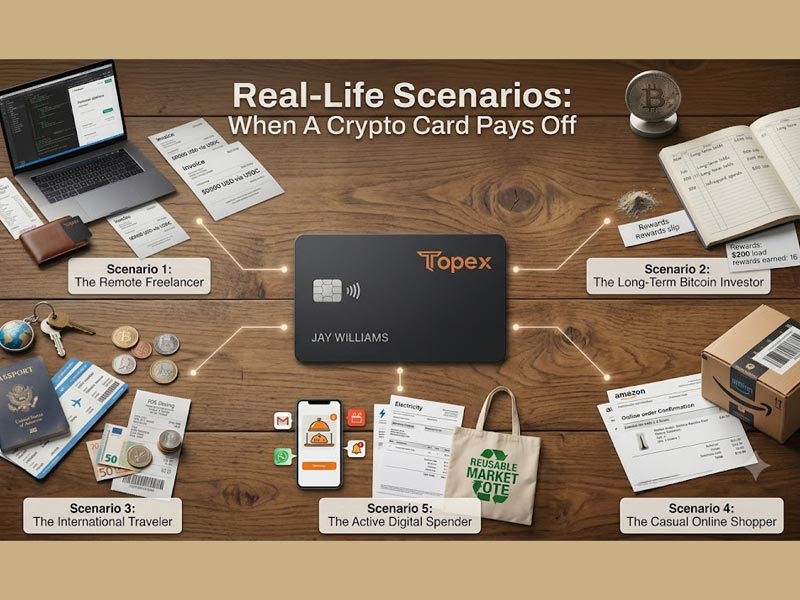
Real-Life Scenarios: When a Crypto Card Pays Off, and When It Doesn’t
The clearest way to judge whether a crypto card is worth it is to compare your situation to realistic spending scenarios rather than abstract benefit lists.
Scenario 1: The Remote Freelancer Paid in Crypto
A freelancer receives 60% of their monthly income in USDC. They use the card weekly for groceries, subscriptions, and dining. They avoid exchange fees, bank transfer delays, and double conversion costs. Annual savings versus the sell-then-spend route easily exceed any card fees. Worth it: clearly yes.
Scenario 2: The Long-Term Bitcoin Investor
A user buys Bitcoin monthly and plans to hold for 5+ years. They load $200 on the card every few months for an occasional purchase. Most of that balance sits unused, exposed to price swings. Annual fees and conversion costs exceed any rewards earned. Worth it: no, manual conversion when needed is more efficient.
Scenario 3: The International Traveler
A user travels across 4–5 countries per year. They load the card with stablecoins before each trip and spend through local POS terminals and online bookings. They avoid foreign transaction fees that traditional debit cards charge at 1–3%. Worth it: yes, especially for trips over two weeks. For travel-specific selection criteria, our guide on where to buy a crypto card for travel covers what to prioritize before booking.
Scenario 4: The Casual Online Shopper
A user buys online occasionally, maybe 3–4 transactions per month, and holds a small crypto balance. The transaction volume is too low to accumulate meaningful rewards, and conversion costs absorb most of the benefit. Worth it: borderline, often not justifiable.
Scenario 5: The Active Digital Spender
A user runs subscriptions, food delivery, and most online purchases through the card. They fund with stablecoins, spend predictably, and benefit from the simplicity of one consolidated payment tool. Worth it: yes, particularly if the card has transparent pricing.
What Makes a Crypto Card Actually Worth Applying For
A crypto card is only worth applying for if it meets a short list of practical criteria that protect your finances and match your usage. Without these, even an attractive marketing pitch quickly turns into a cost trap.
The non-negotiable features to check before applying:
- Transparent fee structure: No hidden conversion spreads, clear top-up costs, visible withdrawal limits.
- Low or zero top-up fees: Recurring funding shouldn’t quietly tax every transaction.
- Reasonable issuance cost: A one-time charge is acceptable; high monthly fees usually aren’t.
- Fast KYC and quick activation: The onboarding process should match the speed advantage that crypto cards are supposed to offer.
- Broad merchant acceptance: Visa or Mastercard network support is essential for real-world usability.
- Digital wallet compatibility: Apple Pay and Google Pay support extend the card’s practical reach.
- Strong transaction security: Advanced encryption and active fraud monitoring should be the baseline.
- Responsive customer support: Issues with payments require fast resolution, especially across time zones.
If a card fails on more than two of these, applying rarely pays off regardless of the reward percentage advertised. For a deeper look at the value side of the equation, our overview of crypto card benefits explains which features deliver the highest practical return.
How Topex Card Aligns With These Criteria
The Topex Card is designed for users who want a clear, low-cost way to spend digital assets without manual conversion. It offers full transparency with zero hidden fees, completely free account top-ups, and a one-time card issuance fee of just $1, which keeps the cost-benefit math straightforward from day one.
Topex supports global spending and borderless payments, with acceptance at millions of POS terminals and online payment gateways worldwide. You can also use TopexCard with Apple and Google Pay for seamless contactless transactions, and the KYC process is fast and simple, so activation takes minutes rather than days. Advanced transaction encryption and 24/7 dedicated customer support handle the security and reliability side, removing the common friction points that make other crypto cards stop being worth using over time.
A 7-Question Self-Test to Know If You Should Apply for a Crypto Card
Deciding whether to apply comes down to running your own profile against a short, honest checklist rather than relying on general advice. If you can answer yes to most of the questions below, applying is likely worth it.
- Do you currently hold crypto or expect to receive crypto income within the next 6 months?
- Will you make at least 15–25 transactions per month through the card?
- Are you comfortable funding the card with stablecoins to manage volatility?
- Do you regularly shop online, travel internationally, or pay for digital services?
- Have you compared the total fees (not just the headline rate) of at least two providers?
- Does your preferred card offer transparent pricing, low or zero top-up fees, and broad merchant acceptance?
- Have you separated your long-term holdings from the funds you plan to spend through the card?
A “yes” on five or more questions usually means the card will pay off. Fewer than three, and applying probably isn’t the right move yet. The checklist is more reliable than any reward percentage because it tests your real behavior, not aspirational habits.
Final Thoughts on Whether a Crypto Card Is Worth It
Ultimately, the answer to Is a Crypto Card Worth It? depends less on the product itself and more on how naturally it fits into your financial habits. For people who already earn, hold, and spend crypto regularly, a well-structured card can simplify payments, unlock rewards, and make digital assets feel more practical in daily life. For those who mainly treat crypto as a long-term investment or spend from it only occasionally, the benefits are often too small to outweigh the effort, fees, or exposure to price fluctuations. In other words, a crypto card is not automatically valuable; it becomes worth it only when it aligns with how you actually use your money, not how you think you might use it in the future.
Important Questions Before Using a Crypto Card
Do crypto cards make sense for someone who only invests long-term?
Generally no. If you rarely spend from your crypto holdings and treat them as a multi-year investment, a card adds friction, exposes balances to volatility, and accumulates fees that outweigh any rewards. Long-term holders are better served by manual conversion when they actually need fiat.
How often do I need to use a crypto card for it to be worth applying for?
You typically need at least 15–25 transactions per month, or several uses per week, for a crypto card to clearly pay off. Below that threshold, fixed costs like conversion spreads and any subscription fees dilute the value faster than rewards can compensate.
Can a crypto card still be worth it during volatile market conditions?
Yes, if you fund the card with stablecoins like USDT or USDC instead of volatile assets. Stablecoin funding eliminates price-swing risk on your loaded balance while preserving every other practical benefit, including global spending, low fees, and digital wallet compatibility.
Is a crypto card worth it for someone wanting to earn passive income?
No, a crypto card is a spending tool, not an income product. If your goal is to grow holdings rather than spend them, dedicated yield-generating strategies such as staking, lending, or liquidity provision deliver returns the card cannot match. A crypto card becomes worth it only when active spending is genuinely part of your financial plan