

You earn rewards with a crypto card by using it for everyday purchases that qualify for cashback, loyalty points, or token-based perks tied to your card’s rewards program. Understanding how to earn rewards using a crypto card starts with knowing that the exact amount you earn depends on the card’s reward structure, your spending categories, and any tier or holding conditions set by the provider. Crypto card rewards have evolved into a practical way to grow digital assets through routine spending rather than active trading. This guide explains how reward systems actually work, the different types of rewards available, smart strategies to maximize earnings, and the common mistakes that quietly reduce your effective return. Ready to turn every purchase into an opportunity?
Key Takeaways:
- Crypto card rewards are earned automatically when you spend on eligible purchases, with payouts in cashback, loyalty points, tokens, or stablecoins, depending on the card.
- Effective net rewards across the market generally cluster between 0.8% and 3% for everyday cashback, though some tiered programs advertise up to 5–6%.
- Reward structures fall into four main models: flat-rate, tiered, category-based, and staking-boosted, each suited to different spending habits.
- Maximizing rewards requires matching your card’s reward categories to your actual spending patterns rather than chasing the highest advertised rate.
- Hidden fees like FX spreads, conversion charges, and ATM withdrawals can quietly reduce your real reward value by 1–2 percentage points.
- Loyalty tiers and merchant partnerships often unlock the highest reward rates, but require consistent card usage to maintain.
- Storing earned rewards in stablecoins protects their value from market volatility, while holding native tokens offers higher upside potential.
What Are Crypto Card Rewards?
Crypto card rewards are incentives you receive in the form of cryptocurrency, loyalty points, or merchant perks every time you use your card for qualifying purchases. Unlike traditional cashback paid in fiat, these rewards arrive as digital assets that can appreciate or be reinvested.
The mechanics are simple on the surface: you spend, the card calculates your earned reward as a percentage of the transaction, and the asset is credited to your account. Behind the scenes, the card network handles authorization and settlement just like any Visa or Mastercard payment, while the reward calculation happens through the provider’s program rules.
What makes crypto card rewards distinct is the asset itself. A 2% cashback on a $100 purchase delivers $2 worth of Bitcoin, USDT, or a native token, rather than a fixed dollar amount. That single difference changes how rewards behave over time, since their value can rise or fall with the market.
Want to understand the underlying product first? Reading a clear explanation of what a crypto card is will give you the foundation needed to make sense of any reward program.
How Do Crypto Card Rewards Actually Work?
Crypto card rewards work by tracking your eligible spending, applying a predefined reward rate, and depositing the calculated amount into your linked account, usually in real time or within the billing cycle. The process is automated and tied directly to the card’s transaction system.
When you tap or swipe your card, the payment is processed through standard card networks. The reward engine then checks the merchant category, the transaction amount, and your current tier status to determine the payout. Some providers credit rewards instantly, while others batch them daily or monthly.
The asset you receive depends entirely on the card. Some cards pay rewards in Bitcoin, others in stablecoins like USDT, and some in their own native token. A few flexible programs let you choose your reward asset before each billing period.
The Step-by-Step Reward Flow:
Here’s exactly what happens from purchase to payout:
- Make a purchase with your crypto card at any merchant that accepts the card network.
- The transaction is processed through the standard payment rails, just like a regular debit or credit card.
- The reward engine calculates your earnings based on the merchant category, transaction amount, and tier status.
- The reward is credited to your linked account or wallet, either instantly or at the end of the billing cycle.
- You decide what to do with the earned crypto: hold, convert to stablecoins, stake, or spend it again.
If you’re new to funding your card, learning how to top up a crypto card properly will make the entire spending and earning loop smoother.
How Are Crypto Card Rewards Calculated?
Crypto card rewards are calculated by applying the card’s reward rate to the eligible transaction amount, then converting that value into the chosen reward asset at the current market price. The calculation happens automatically the moment a purchase clears.
The formula is straightforward in most cases: transaction amount × reward rate = reward value in fiat equivalent. That fiat value is then converted into crypto using the spot price at the time of payout. For example, a $200 purchase with a 2% reward rate generates $4 worth of crypto, which is then deposited as BTC, USDT, or another supported asset based on its market price at that moment.
The complexity comes in when tiered rates, category bonuses, or staking multipliers apply. Cards with tiered structures check your monthly spending or stakeholder balance before assigning the correct rate. Category-based programs verify the merchant code to decide whether the boosted rate or base rate applies.
Factors That Affect the Final Reward Amount:
The following variables determine what you actually receive:
- Base reward rate assigned by the card’s program tier
- Merchant category code (MCC), which triggers bonus or excluded rates
- Monthly spending caps that cut off the higher rate after a threshold
- Conversion timestamp since crypto prices fluctuate between purchase and payout
- Eligibility filters that exclude transactions like ATM withdrawals or transfers
- Active promotions that temporarily boost the standard rate
Understanding this calculation logic helps you predict your earnings before you spend, rather than being surprised at the end of the cycle.
When Do You Receive Your Crypto Card Rewards?
You receive crypto card rewards either in real time at the moment of purchase, daily through batched payouts, or at the end of your monthly billing cycle, depending entirely on the card provider. Payout speed has a real impact on the value you ultimately keep.
Real-time payouts: deposit your reward the moment a transaction clears. This model is favored by users who want to capture price movements immediately, since the reward asset is in your account and can appreciate from that point forward. Cards with real-time rewards are particularly valuable in volatile markets, where waiting weeks for a payout could mean missing significant upside or absorbing a price drop.
Batched payouts group your rewards by day, week, or billing cycle and deposit them as a single transaction. This model simplifies tracking but locks the conversion price to a specific date, which may or may not work in your favor. End-of-cycle payouts are most common with credit-style cards that align rewards with the statement period.
Common Payout Timelines:
Different providers use different schedules:
- Instant payouts are credited at the moment the transaction clears
- Daily batched payouts, grouped at the end of each business day
- Weekly payouts are processed on a fixed day of the week
- Monthly payouts are aligned with the billing or statement cycle
- Threshold-based payouts, released only after reaching a minimum balance
Always check the payout schedule before signing up, especially if you plan to use rewards as part of a short-term strategy.
What Types of Crypto Card Rewards Can You Earn?
Crypto card rewards come in several distinct forms, each with different payout mechanics and value behavior. Understanding which type of card offers is more important than the headline percentage, because the structure determines what you actually keep.
The four most common reward types are direct crypto cashback, stablecoin cashback, loyalty points, and token-based rewards. Some cards mix two or more of these into a hybrid program.
Direct Crypto Cashback
Direct crypto cashback pays a percentage of every eligible purchase back in cryptocurrency, typically Bitcoin or Ethereum. The reward value moves with the market, so a 2% cashback in BTC could grow or shrink depending on price action after payout.
This type works best for users who already believe in the long-term value of major cryptocurrencies. Real-time payouts are especially valuable here, since they let you capture price movements right from the moment of purchase.
Stablecoin Cashback
Stablecoin cashback delivers rewards in USDT, USDC, or similar fiat-pegged tokens. The main advantage is value stability; the reward you earn today is worth roughly the same amount tomorrow, regardless of crypto market swings.
This option suits users who want predictable returns or plan to use their rewards for further spending. It’s also the easiest model to evaluate, since the cashback rate translates directly into real purchasing power.
Loyalty Points and Merchant Perks
Loyalty points are program-specific credits that you accumulate based on spending volume or tier status. These points unlock exclusive perks like merchant discounts, higher reward tiers, or partner benefits that go beyond simple cashback.
Points-based systems reward consistent usage. The more you spend within the ecosystem, the more valuable your perks become, sometimes including travel benefits, premium subscriptions, or boosted earning rates at partner merchants.
Token-Based Rewards
Token-based rewards pay out in the card provider’s native token. These often advertise the highest rates, but the actual value depends on the token’s market performance and any vesting or lock-up rules.
Token rewards can offer significant upside during bull markets, but they carry concentrated risk if the token underperforms. Always check whether the token has real utility within the ecosystem before treating its rate as your true return.
What Are the Main Reward Structures Used by Crypto Cards?
Crypto cards use four main reward structures: flat-rate, tiered, category-based, and staking-boosted. Each structure determines how much you earn and what conditions you need to meet.
Picking the right structure matters more than chasing the highest advertised rate. A 5% reward locked behind heavy staking requirements may deliver less real value than a clean 2% flat rate with no conditions.
Flat-Rate Rewards
Flat-rate cards pay the same percentage on every eligible purchase, with no categories or tiers to track. Rates typically range from 1% to 3%, making them simple and predictable.
This structure is ideal for users who want transparency. You know exactly what you’ll earn before you spend, and there’s no need to optimize your shopping habits to hit higher rates.
Tiered Rewards
Tiered programs increase your reward rate based on factors like monthly spending volume, account balance, or staked token holdings. Higher tiers often unlock 3–6% cashback, but they require meaningful commitments.
Tiers reward loyalty and scale. They work best for high-volume spenders or users who plan to hold significant crypto balances with the provider anyway. For lower spenders, the base tier rate is what truly matters.
Category-Based Rewards
Category-based cards offer boosted rates on specific spending types, such as dining, travel, groceries, fuel, or streaming subscriptions. Common boosts range from 3% to 6% in select categories, with a lower base rate everywhere else.
To benefit from this model, your actual spending must align with the bonus categories. A travel-focused card delivers little value if you rarely travel, no matter how attractive the headline rate looks.
Staking-Boosted Rewards
Staking-boosted programs require you to lock up native tokens to unlock higher reward tiers. The trade-off is straightforward: more staked tokens equal higher cashback rates, but your capital is tied up.
Run the math before staking. If staking $2,000 raises your reward rate from 1% to 3% on $1,000 monthly spending, that’s an extra $240 per year, against the opportunity cost and volatility risk of holding the locked tokens.
How Do You Maximize Crypto Card Rewards?
You maximize crypto card rewards by matching your spending pattern to the card’s reward structure, using the card for high-volume recurring expenses, and avoiding fees that quietly reduce your net earnings. Smart card selection is the foundation, but ongoing optimization is what separates passive users from strategic earners.
Most users leave significant value on the table by failing to align their actual spending with their card’s strongest categories. A few simple habits can boost your effective return by 50% or more without changing your lifestyle.
Smart Strategies to Boost Your Earnings:
The following strategies consistently deliver higher net rewards across most crypto card programs:
- Route recurring expenses through the card, including subscriptions, groceries, fuel, and utility payments where accepted.
- Use the card for category bonuses, especially if your spending naturally falls into dining, travel, or streaming.
- Take advantage of promotional periods like double-cashback weekends, holiday boosts, or new-merchant launches.
- Top up the asset you plan to spend to avoid unnecessary in-app conversion fees that erode your reward margin.
- Monitor tier requirements and adjust your spending or holdings if a small increase pushes you into a higher reward bracket.
- Combine staking with spending when the math justifies it, locking tokens only if the boosted rate outweighs the opportunity cost.
- Store rewards strategically by converting to stablecoins during volatile periods or holding in BTC when you expect appreciation.
For users who treat earned rewards as a long-term asset, learning how to make passive income with crypto opens up additional ways to compound your earnings beyond simple spending.
What Affects Your Real Reward Value?
Your real reward value is the cashback rate minus all fees, spreads, and conversion costs applied throughout the spending and earning cycle. The advertised rate is rarely what you actually keep.
Several hidden factors can reduce your net reward by 1–2 percentage points or more. Tracking these costs is essential to understanding whether a card truly delivers on its promise.
Fees That Reduce Your Net Reward
Watch for these common cost categories that eat into your earnings:
- Foreign transaction fees, which can range from 0.5% to 3% on international purchases.
- FX spreads, where the card converts crypto or fiat at rates wider than the market price.
- In-app conversion charges when swapping between crypto assets to top up or cash out.
- ATM withdrawal fees are charged both by the card provider and the operating network.
- Monthly maintenance fees on some premium tiers or specific card types.
- Inactivity penalties if the card isn’t used for a defined period.
Reading a detailed breakdown of crypto card benefits before choosing a card helps you spot which providers actually deliver clean reward value versus those that recover their costs through hidden charges.
Market Volatility
Crypto rewards paid in volatile assets like BTC or native tokens can gain or lose value after deposit. A 3% cashback in a token that drops 20% the following week effectively becomes a 2.4% reward.
Volatility cuts both ways. The same reward could appreciate significantly during a bull market, which is part of the appeal for users with longer time horizons.
Do Crypto Card Rewards Expire?
Most crypto card rewards do not expire once they are deposited into your account, but expiration rules can apply to unredeemed points, promotional bonuses, or rewards tied to active card membership. The exact policy depends on the provider’s terms.
Rewards paid directly in cryptocurrency, like BTC or stablecoins, are generally treated as your asset the moment they hit your account. They sit in your wallet or linked exchange balance until you decide to spend, hold, or convert them. There’s no countdown clock attached to the asset itself.
The picture changes for points-based programs and promotional rewards. Loyalty points may have expiration windows ranging from 12 to 24 months of account inactivity. Sign-up bonuses or referral rewards often come with redemption deadlines, and some programs forfeit unredeemed points if the card is closed or downgraded.
Reward Expiration Rules to Watch:
Pay attention to these conditions that can trigger reward loss:
- Account inactivity periods, often 6 to 24 months without a qualifying transaction
- Card closure or downgrade, which may forfeit unredeemed points or pending bonuses
- Tier demotion that can reduce or eliminate rewards earned at a higher tier
- Promotional reward windows with strict redemption deadlines
- Token unlock or vesting schedules for native token rewards
- Terms-of-service changes that retroactively adjust reward eligibility
To protect your earnings, withdraw or convert your rewards regularly rather than letting them sit in program accounts indefinitely.
What Are the Common Mistakes That Reduce Crypto Card Rewards?
The biggest reward losses come from choosing a card based on the headline rate, ignoring fees, and failing to align spending with bonus categories. These mistakes are easy to fix once identified.
Avoiding the following pitfalls will protect your effective reward rate and improve long-term returns.
Mistakes to Avoid:
- Chasing the highest advertised rate without checking the conditions, caps, or tier requirements behind it.
- Ignore foreign transaction fees when using the card for travel or international online purchases.
- Converting assets unnecessarily at checkout or during top-up, which triggers avoidable spreads.
- Letting rewards sit idle in volatile assets without a clear hold-or-convert strategy.
- Missing promotional windows that could double or triple your earnings during specific periods.
- Failing to track spending categories and missing out on bonus rates available through the same card.
- Holding the wrong reward asset for your goals, such as keeping volatile tokens when you need stable purchasing power.
Some users also overlook the structural differences between card types, which directly affect how rewards are calculated. Understanding the difference between crypto debit cards and crypto credit cards clarifies which option matches your spending behavior and risk tolerance.
How to Choose the Right Crypto Card for Maximum Rewards?
Choosing the right crypto card means matching the reward structure to your monthly spending pattern, evaluating the total fee load, and confirming the card is supported in your region. The best card is the one that delivers the highest net return on your actual spending, not the one with the flashiest marketing.
Start by tracking your typical monthly expenses across categories. Then compare cards based on how their reward structure performs against that specific pattern.
Comparison of Reward Structures:
| Structure | Best For | Typical Rate | Key Consideration |
|---|---|---|---|
| Flat-Rate | Predictable spenders | 1–3% | Simple and transparent, no optimization needed |
| Tiered | High-volume users | 2–6% | Requires meeting spend or balance thresholds |
| Category-Based | Specialized spending | 3–6% in bonus categories | Only valuable if your spending matches categories |
| Staking-Boosted | Long-term crypto holders | Up to 5–8% | Locks capital and adds volatility risk |
Key Selection Criteria
Use these criteria to evaluate any crypto card before signing up:
- Reward rate after caps and conditions, not the headline number.
- Asset choice flexibility, including the option to receive stablecoins or major cryptocurrencies.
- Fee structure transparency, with clear disclosure of FX, conversion, and maintenance costs.
- Regional availability and supported merchants for the locations where you actually spend.
- Payout speed, with real-time deposits being preferable to monthly batching.
- Custody model, whether the provider holds your assets or you maintain self-custody.
If you’re still weighing whether the overall package justifies the switch, reviewing whether a crypto card is worth it for your specific use case is a smart next step before committing.
Earn Effortlessly with the Topex Crypto Card
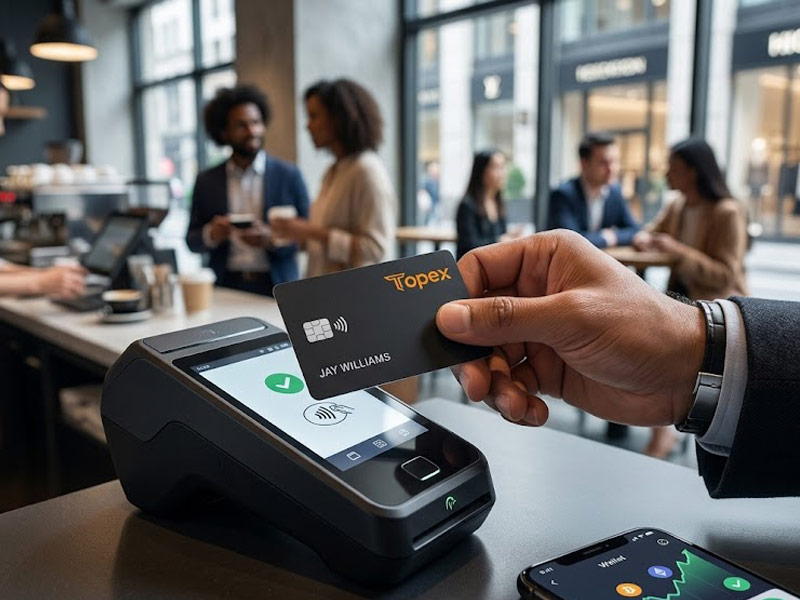
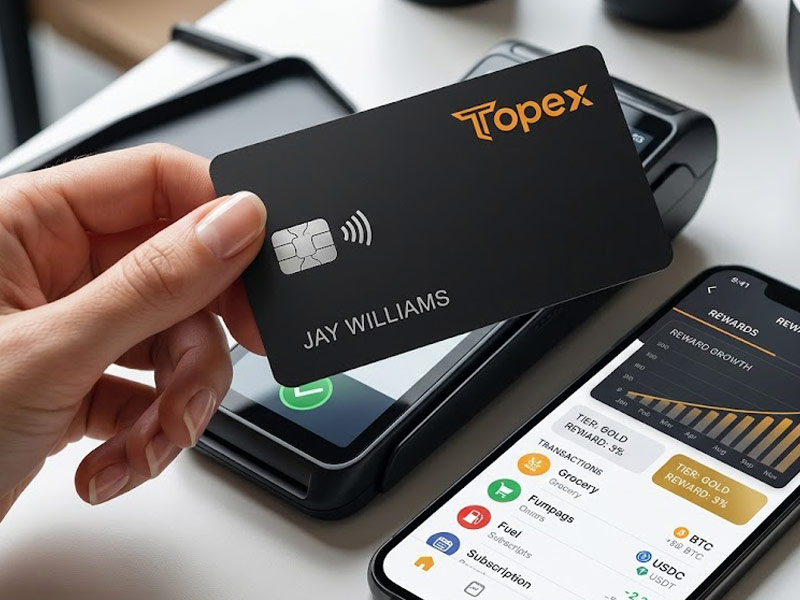
The Topex Crypto Card is designed to make spending and earning with digital assets straightforward, with a focus on transparency and global usability. Built around a simple structure, it lets you spend crypto directly in daily life without manual conversion to fiat, removing the friction that often gets in the way of using your assets.
Topex stands out with a clear fee structure: top-ups are completely free, and the card issuance fee is just $1, with full transparency and zero hidden fees. You can also use TopexCard with Apple and Google Pay, making it even easier to pay seamlessly at millions of POS terminals and online payment gateways worldwide. The platform is further protected with advanced transaction encryption and high-level security standards.
With fast and simple KYC, 24/7 dedicated customer support, and global borderless payments, Topex offers a streamlined way to put your crypto to work across everyday spending.
Final Thoughts on How to Earn Crypto Card Rewards
Successfully learning how to earn rewards using a crypto card is really about matching the right reward structure to your actual spending habits. The users who consistently benefit are those who pay attention to net value after fees, choose reward assets that align with their goals, and use the card strategically for high-volume recurring expenses.
The most reliable approach is to start with clean, transparent reward terms, build the habit of routing predictable spending through the card, and only commit to staking or tiered programs when the math clearly works in your favor. Treat your reward asset choice with the same care as any other crypto decision, since volatility, fees, and program rules all shape what you ultimately keep.
A well-chosen crypto card can turn routine spending into a steady stream of digital assets without changing how you live.
Key Questions About Crypto Card Rewards
Can you earn rewards with crypto cards?
Yes, you can earn rewards with crypto cards on every eligible purchase, typically in the form of cashback, loyalty points, stablecoins, or native tokens. Reward rates commonly range from 1% to 3% on standard programs, with some tiered or category-based cards offering up to 5–6% on qualifying spending. The reward is credited automatically to your linked account either instantly or at the end of the billing cycle.
How do crypto credit card rewards programs work?
Crypto credit card rewards programs work by extending you a credit line that you spend in fiat, then converting a percentage of each purchase into cryptocurrency and depositing it into your linked account. Rewards are usually paid at the end of the billing cycle and often offer higher rates of 2–5% because they’re tied to a borrowing model. You repay the spent amount in fiat, while the reward arrives as BTC, ETH, or a chosen crypto asset.
How do crypto debit card rewards programs work?
Crypto debit card rewards programs work by deducting funds directly from your pre-loaded crypto balance at the point of sale, then crediting a percentage back as a reward, often in real time. Reward rates typically range from 1–3% and are paid instantly because the transaction is settled immediately rather than billed later. You spend what you already own, with no credit check or borrowing involved.
How much can you realistically earn with a crypto card?
Most users earn between 0.8% and 3% in effective net rewards on everyday spending. Higher rates of 4–6% exist on tiered or category-based programs, but they typically require meeting spending thresholds, staking native tokens, or spending in specific bonus categories.
Are crypto card rewards paid instantly or at the end of the billing cycle?
It depends on the card. Some providers credit rewards in real time at the moment of purchase, which lets you capture price movements immediately. Others batch rewards daily or at the end of the monthly billing cycle, which delays access but simplifies tracking.
Can you earn rewards on every type of purchase?
Not always. Most cards exclude certain categories like ATM withdrawals, money transfers, gambling, and cryptocurrency purchases from reward eligibility. Always check the card’s terms to confirm which transactions qualify before optimizing your spending.
Is it better to earn rewards in stablecoins or volatile crypto?
Stablecoins offer predictable value and easier reward management, while volatile assets like BTC or ETH carry upside potential along with downside risk. The right choice depends on your time horizon and whether you treat rewards as savings or long-term investments.