

No, Bitcoin is not dead in 2026. Bitcoin has been declared dead more than 470 times since 2010, and every single time, the network kept producing blocks every ten minutes, ETFs kept buying, and the price eventually recovered. The “Is Bitcoin dead?” question usually appears during price corrections, but price and network health are two very different things. This article breaks down what the 2026 data actually shows, why people keep asking the question, which risks are real, and how Bitcoin is being used in daily life today. By the end, you’ll be able to tell the difference between a temporary pullback and an actual collapse.
Key Takeaways:
- Bitcoin has been declared dead over 470 times since 2010, yet the network has maintained near-100% uptime for more than 17 years.
- U.S. spot Bitcoin ETFs accumulated over $53 billion in inflows by April 2026, with combined ETF assets surpassing $102 billion.
- The Bitcoin network hashrate hit a record above 1 ZH/s (1,000 EH/s) in early 2026, making it the most secure computer network ever built.
- Bitcoin’s four-year halving cycle has weakened in 2026 as institutional flows and global liquidity now drive price more than mining rewards.
- Major banks like BlackRock, Fidelity, JPMorgan, and Bank of America now recommend 1–5% crypto allocations to clients.
- Bitcoin is increasingly used as a spendable asset through crypto debit cards, not just a speculative trade.
- The real risks in 2026 are regulation, custody failures, and quantum computing, none of which have “killed” Bitcoin so far.
Why Bitcoin Is Still Very Much Alive?
Bitcoin isn’t dead because the things that would actually kill it, network failure, zero adoption, or complete loss of users, have not happened. The price has corrected from its late-2025 highs near $110,000 down to a range between $70,000 and $85,000 through most of 2026, but a price drop is not a death sentence.
Look at the numbers that actually measure network health. The Bitcoin hashrate sits around 880–1,000 EH/s in May 2026, an all-time high range. ETF inflows continue to absorb supply faster than miners can produce it. Public companies, sovereign treasuries, and pension funds now hold over 2.6 million BTC combined. That’s not what a dying asset looks like.
“When you look at usage, developer activity, institutional flows, and infrastructure signals, the story is very different from the headlines.”
The narrative of death keeps recycling because it’s emotionally satisfying during downturns. The data tells a different story.
Why People Keep Asking “Is Bitcoin Dead?”
The question reappears in cycles because three things repeat: price crashes, media incentives, and human psychology. Each one feeds the next.
Price Crashes Trigger Death Predictions
Bitcoin has survived drops of 93% in 2011, 87% in 2014, 84% in 2018, and 77% in 2022. Every one of those crashes produced waves of obituaries. In 2026, Bitcoin pulled back roughly 36% from its all-time high near $110,000, and the “Bitcoin is dead” headlines returned, though with noticeably less volume than in past cycles.
This pattern is consistent. Drops of 50% or more in any volatile asset produce panic, and panic produces clickable headlines.
Media Headlines and Click Incentives
“Bitcoin is dead” works as a headline. It’s short, dramatic, and emotionally charged. Bloomberg, Forbes, the Financial Times, and dozens of other publications have all published Bitcoin obituaries, often multiple times. The incentive isn’t accuracy. It’s traffic.
Pay attention to who’s saying Bitcoin is dead and why. A Nobel-prize-winning economist making a philosophical argument is different from a trader who bought the top.
The 472 Obituaries Problem
A running tally tracked by industry researchers shows Bitcoin has been declared dead 472 times since December 2010, when the first obituary appeared, and Bitcoin was worth $0.11. If you’d invested $100 every time someone declared Bitcoin dead, you’d hold around 1,043 BTC today.
The pattern is so reliable that obituaries have become a contrarian indicator. When everyone says it’s over, the bottom is usually close.
The Real Health Metrics That Prove Bitcoin Is Alive
Price is the noisiest signal in crypto. The signals that actually matter are network security, adoption, and on-chain activity. All three are at or near record highs in 2026.
Hashrate and Network Security
Hashrate measures how much computing power is securing the Bitcoin network. More hashrate means more security and a higher cost to attack. Bitcoin’s network hashrate broke 1 ZH/s for the first time in early 2026, and even after a winter storm in Texas temporarily knocked 30–40% of U.S. mining capacity offline, the network recovered within weeks.
A dying network loses miners and security. Bitcoin gained both, even through a major price correction.
ETF Inflows and Institutional Adoption
U.S. spot Bitcoin ETFs have absorbed over $53 billion in net inflows since their January 2024 launch, more than triple what analysts originally predicted. BlackRock’s IBIT alone holds around $54 billion in assets and controls roughly 60% of the total ETF market.
Key adoption signals in 2026:
- Combined Bitcoin ETF assets exceed $102 billion globally.
- Public companies, ETFs, and sovereign treasuries hold over 2.6 million BTC.
- Wealth managers at JPMorgan and Bank of America now recommend 1–5% crypto allocations.
- The U.S. Senate Banking Committee scheduled a review of the Digital Asset Market Clarity Act in mid-2026.
This is institutional money. It moves more slowly, holds longer, and doesn’t panic-sell.
On-Chain Activity and Daily Transactions
The Bitcoin network processes transactions 24/7, 365 days a year, with roughly 99.98% uptime since 2009. Stablecoin settlement volume across crypto hit $27.6 trillion in 2024, larger than Visa and Mastercard’s annual transaction totals combined. That activity hasn’t stopped in 2026.
Developer Activity
Open-source developers continue to ship code on Bitcoin Core, Lightning, and second-layer protocols. Developer activity is a strong signal of long-term health because builders don’t waste years on dead projects.

What “Died”, and Why That Isn’t Bitcoin Dying
Something did die in 2026, but it wasn’t Bitcoin. It was the simple, predictable four-year halving cycle that retail traders had treated as gospel.
The End of the Pure Four-Year Cycle
Historically, the year after a halving delivered double or triple-digit returns. 2013, 2017, and 2021 all followed the pattern. Then 2025 broke it, the post-halving year closed roughly 6% lower than it opened, the first time that’s happened.
Researchers now argue the cycle was never really about mining rewards. It tracked global liquidity and post-2008 monetary policy. With Bitcoin now influenced more by Federal Reserve decisions than miner economics, the four-year clock has effectively been replaced by macro cycles.
From Retail Speculation to Institutional Asset
Bitcoin has shifted from a retail-driven speculative asset to a macro-correlated portfolio holding. A recent Binance Research report shows Bitcoin’s correlation with global central bank easing has flipped; it now leads policy expectations rather than lagging them.
This is maturation, not death. But it’s confusing for anyone still using 2017-era playbooks.
Real Risks That Could Actually Threaten Bitcoin
Not every concern is hysteria. Some risks are worth tracking honestly.
- Regulatory crackdowns: Hostile legislation in a major economy could damage liquidity and access. The 2026 U.S. regulatory environment is friendlier, but this can shift quickly.
- Quantum computing: A sufficiently powerful quantum computer could theoretically break Bitcoin’s signature scheme. The threat is years away, and quantum-resistant upgrades are already being researched.
- Custody and exchange failures: Mt. Gox in 2014 and FTX in 2022 both wiped out billions. The protocol survived; users didn’t. Self-custody and regulated custodians reduce this risk.
- Mining concentration: A growing share of hashrate sits in the U.S. (35–40%). Geographic diversification reduces single-point-of-failure risk.
- Loss of relevance: Unlikely, but if a superior technology emerges and developers migrate, Bitcoin could slowly fade. No serious challenger exists in 2026.
These are real, but none of them have killed Bitcoin so far. The network has weathered every major one.
How Bitcoin Is Actually Used in 2026
Bitcoin’s role today is broader than “speculate and HODL.” It functions as a store of value, a settlement layer, and increasingly, a spendable asset in daily life.
Store of Value vs Medium of Exchange
Most institutional holders treat Bitcoin like digital gold, a hedge against currency debasement and a portfolio diversifier. That’s the dominant use case for the $53 billion sitting in ETFs.
But a growing share of users want to actually spend Bitcoin without selling it on an exchange first. This is where crypto payment infrastructure comes in.
What Are Crypto Payment Solutions?
Modern crypto payment infrastructure has become the bridge between holding digital assets and using them in the real economy. What are crypto payment solutions in practice? They include payment processors that accept crypto at checkout, stablecoin rails for cross-border transfers, and crypto debit cards that let holders spend directly at any merchant that accepts Visa or Mastercard. The biggest shift in 2026 is that spending crypto no longer requires a manual conversion step at a crypto exchange. The conversion happens automatically at the point of sale.
Passive Income Opportunities
How to make passive income with crypto? Common approaches include staking proof-of-stake assets, lending crypto through regulated platforms, providing liquidity to decentralized exchanges, and yield-bearing stablecoin strategies. Bitcoin itself doesn’t offer native staking, but wrapped Bitcoin in DeFi and lending markets gives holders ways to generate yield on idle BTC.
Returns vary widely, and so do the risks. Custodial platforms have failed before (Celsius, BlockFi), so the platform you pick matters as much as the strategy.
Spending Bitcoin Without Selling It: The Crypto Card Solution
The biggest practical question for long-term holders in 2026 isn’t whether Bitcoin is dead. It’s how to use it without giving up exposure. Crypto debit cards have become the most common answer.
What Is a Crypto Card?
A crypto card is a Visa- or Mastercard-branded debit card linked to your crypto wallet rather than a traditional bank account. When you spend, the card handles the conversion from crypto to fiat in real time at the point of sale. You get to keep holding Bitcoin (or any supported crypto) as your primary balance, and you spend it like any other card without visiting an exchange every time you need cash. For anyone still asking what a crypto card is and how it differs from a regular debit card, the key is exactly this: your underlying balance stays in crypto until the moment of purchase.
This solves a real friction point. Selling on a crypto exchange to fund daily spending creates taxable events, takes time, and often means waiting on withdrawals. Secure crypto payments through a card removes those steps entirely.
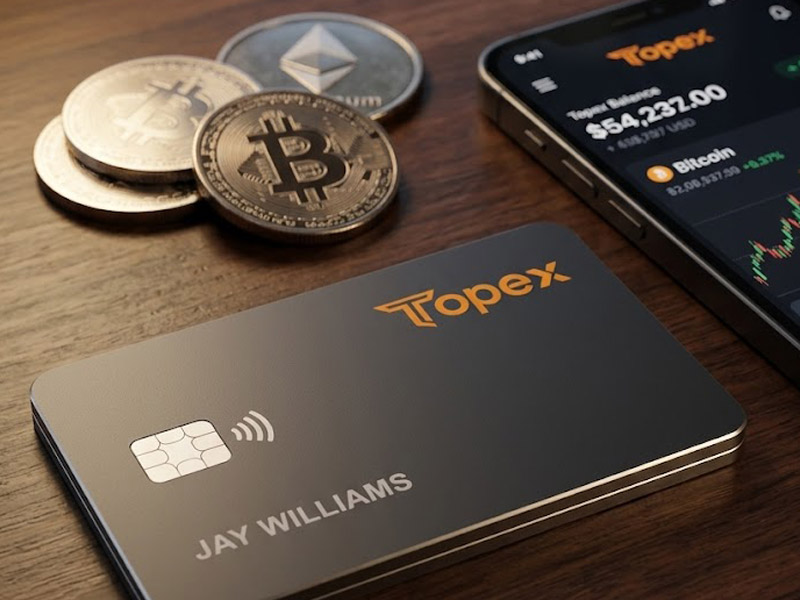
How Topex Card Fits Into This Picture
Topex is one of the crypto debit card options available to users who want to spend digital assets directly. Based on its published feature set, here’s what the standard Topex card offers:
- Direct crypto spending in daily life with no manual fiat conversion required.
- No need to visit physical or online crypto exchanges every time you want to spend.
- Full transparency with zero hidden fees.
- Free account top-ups.
- Card issuance fee of only $1.
- Fast and simple card issuance with quick KYC.
- Global spending and borderless payments.
- Support for digital wallets, including Apple Pay and Google Pay.
- Acceptance at millions of POS terminals and online payment gateways worldwide.
- High security with advanced transaction encryption.
- 24/7 dedicated customer support.
The core appeal is straightforward: your crypto stays as crypto until the moment you spend, and the conversion happens automatically. For anyone holding Bitcoin who’s tired of the exchange-and-withdraw loop, that’s a meaningful change in how digital assets fit into daily life.
“The security of your assets is our priority. With advanced encryption systems and 24/7 support, you can spend with peace of mind anywhere in the world.”
Should You Buy Bitcoin Today?
This is a personal decision that depends on time horizon, risk tolerance, and existing portfolio mix. Wealth managers at major U.S. banks now suggest 1–5% allocations as a baseline.
Which crypto to buy today for the long term? Bitcoin remains the dominant institutional choice because of its scarcity (21 million hard cap), longest network history, and clearest regulatory positioning. Ethereum is the second most-held asset due to its smart contract ecosystem. Other assets like XRP and Solana have institutional interest but smaller track records.
A few practical rules:
- Only allocate what you can afford to lose entirely.
- Use dollar-cost averaging if you’re uncertain about timing.
- Self-custody or regulated custodians reduce platform risk.
- Treat 5-year time horizons as the minimum for thesis-based holding.
- Don’t over-leverage; most retail losses come from liquidations, not Bitcoin itself.
If you can answer “yes” to all of those, allocating to Bitcoin in 2026 is defensible. If not, sit out.
The Future: Bitcoin Beyond 2026
Analyst price targets for end-2026 range widely. Conservative models from major analytics platforms project $85,000–$118,000. More aggressive forecasts from Fundstrat’s Tom Lee target $250,000 by year-end, and Bernstein sees $150,000–$200,000 in 2027.
The bigger picture is more important than any specific target. Bitcoin’s role is shifting from “alternative experiment” to “macro asset class.” That means lower returns than the 100x cycles of the past, but also a lower probability of going to zero. The asymmetric upside narrows. The legitimacy widens.
Realistic expectations for the next 2–3 years:
- Wider trading ranges ($70,000–$150,000) with ETF flows providing a price floor.
- Continued institutional accumulation through Wall Street distribution channels.
- More regulatory clarity in the U.S., EU, and Asia.
- Growing payment infrastructure that makes Bitcoin spendable, not just holdable.
Final Thoughts on the “Is Bitcoin Dead?” Question
Bitcoin isn’t dead in 2026, and the data doesn’t support the obituary headline industry. The network is more secure than ever, institutional capital is committed at record levels, and adoption is broadening from speculation into practical use. What did change is the simple four-year cycle playbook; Bitcoin now trades like a macro asset, not a halving-driven cycle.
The honest takeaway: if you’re using Bitcoin as a long-term holding, the fundamentals support the thesis. If you’re using it for daily spending, the payment infrastructure has matured enough that you no longer have to choose between holding and using your crypto. The right question in 2026 isn’t whether Bitcoin is dead. It’s how you want to use it now that it’s clearly here to stay.
Key Questions About the “Is Bitcoin Dead?” Debate
Has Bitcoin ever been hacked at the protocol level?
No. The Bitcoin network has maintained roughly 99.98% uptime since January 2009 and has never been hacked at the protocol level. Exchange hacks like Mt. Gox and FTX were failures of third-party platforms, not of the Bitcoin network itself.
What price would actually signal that Bitcoin is dying?
Price alone doesn’t signal death; Bitcoin has survived 80%+ drops multiple times. Real signals of decline would be a sustained collapse in network hashrate, a major drop in developer activity, and a clear migration of institutional capital out of ETFs. None of those are happening in 2026.
Does Bitcoin have a future?
Yes. Bitcoin’s future is supported by record-high network security, over $100 billion in ETF assets, and growing adoption by major banks, public companies, and sovereign treasuries. Analysts project continued institutional accumulation and price targets ranging from $150,000 to $250,000 in the next 1–2 years, though volatility will remain part of the picture.
Will Bitcoin ever recover?
Yes, and historically it always has. Bitcoin has recovered from every major crash in its history, including drops of 93% in 2011, 87% in 2014, 84% in 2018, and 77% in 2022, and reached new all-time highs after each one. With ETF inflows now absorbing supply and institutional demand growing, recovery from current corrections follows the same pattern, though timing is never guaranteed.